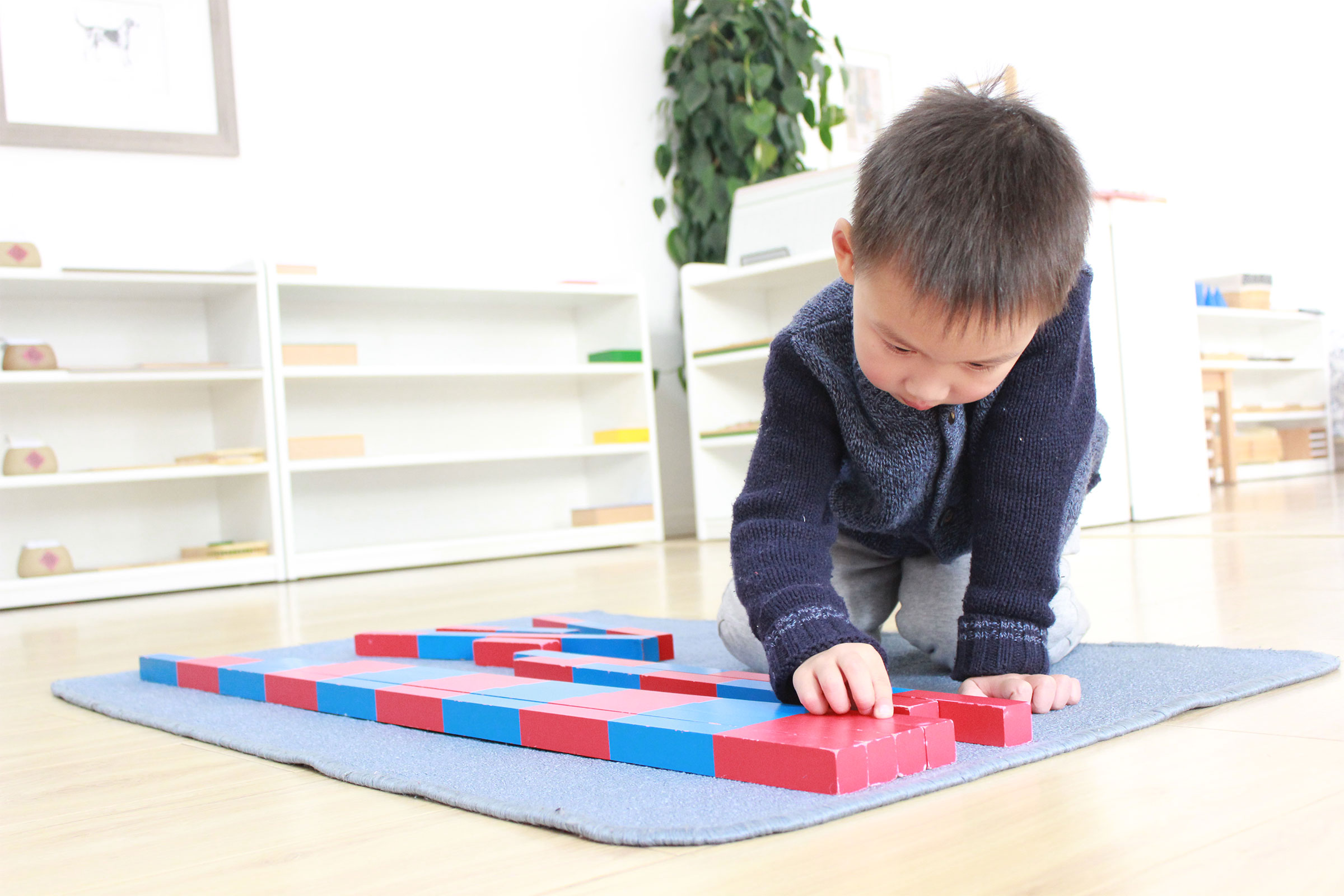
The Sensorial and Mathematical materials in Primary are basic, conceptual materials designed to feed a child’s interest and growing knowledge for several years. How would one know when to rotate one of these materials – as we never know when a child might be interested in or ready for a particular material presentation.
The Sensorial materials have no duplications, perhaps a few refinements, in terms of usage. E.g., the dimensions in the Cylinder Blocks are repeated in the Knobless Cylinders. Same dimensions but different activities (matching to grading the dimensions).
The mathematical materials are sequential and cover the entire age range of a Casa. Each piece of math material gives the child an experience with an isolated mathematical concept so there is nothing conceptually “to rotate”.
Each piece of material is scaffolded on a previous experience. The mathematical materials are organized into groups, each group having a significant purpose. For example, Group 1 – Numbers 1-10 gives various experiences of understanding the basis of the decimal system.
Each piece isolates a single aspect of Numbers 1-10. The Spindle Boxes offer the experience of a number representing either a separate entity or a collection: “These are four individual spindles; this is a group of four spindles (spindles bound together, creating an entity of four).”
As the math materials are each isolating a mathematical concept concretely, gradually leading to the abstraction of the concepts, how could one possibly rotate them?