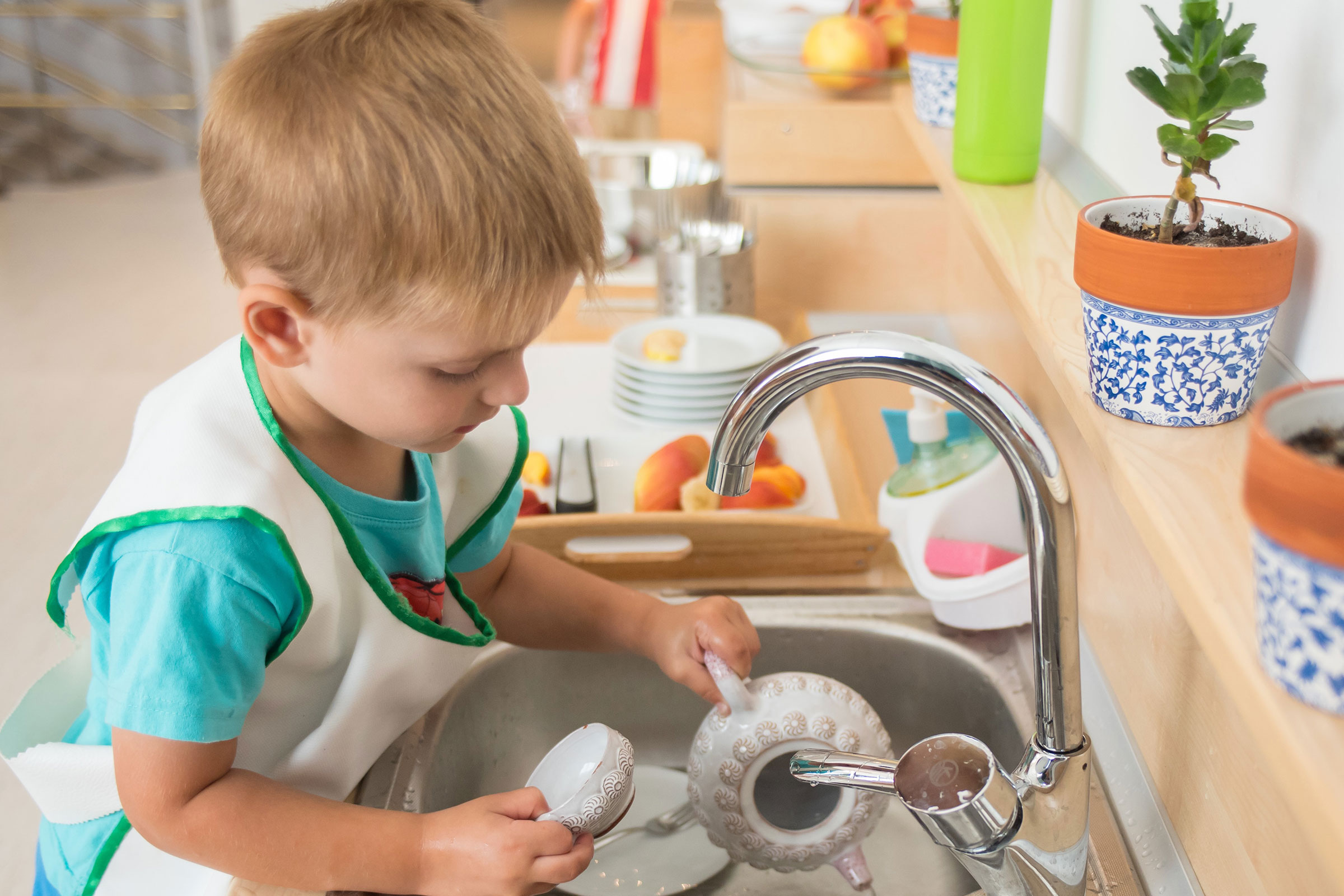
First of all, the time a child could be viewing a screen is time away from living in the real world. Children under the age of 5.5 or 6 need to come to know the real world, to embody that understanding, by working with real things.
This reality gives them a concrete foundation on which to base their imagination in the second plane of development. To connect them – or re-connect them – to the real world, we rely a lot on practical life activities. If a child is under the age of 5–6, they are fascinated by the practical life activities.
They have seen the important people in their lives doing something similar in their homes. The younger a child is, the more the practical life activities challenge/refine their movement abilities. Once they are 4.5 or 5, they do the activities in response to a social need.
Doing these activities allows young children to feel as if they are contributing to the social group. While a young child will be interested in the movements involved in baking bread, an older child will happily bake the bread for lunch or for snack. The motivation changes.
These activities, often undervalued, give the child a reality-based experience in everyday living. They support the development of concentration; they give the child embodied experiences of sequencing a series of actions (if one wants to create soap bubbles, the table must be a bit wet before applying the soap). These activities isolate various movements, thus supporting a child in the refinements of their movement abilities.
Every item used and every action experienced has a name – a name attached to an experience, thus giving clarity to language. Think about these two words (in English): “Need” and “Knead”. Homonyms – but how to explain the difference in meaning when the words are pronounced the same. They will later explore homonyms in some of the Language work.
The real work that a child does involves making a choice of such work, and experiencing the consequences of the choice made. They allow a child to repeat the activity until the child reaches a point of satisfaction rather than an adult saying, “you’ve had a turn; it is now someone else’s turn.” This repetition is one of the pathways to concentration.
Another area in which we prioritize reality is in the content of books we choose to read to the children. They are all reality based, many dealing with everyday life of a child or a family. These books support the magical aspects of real life explorations and discoveries made by children. They are beautifully illustrated; we also recommend some books with no text so that the children can create the stories to go along with the illustrations.