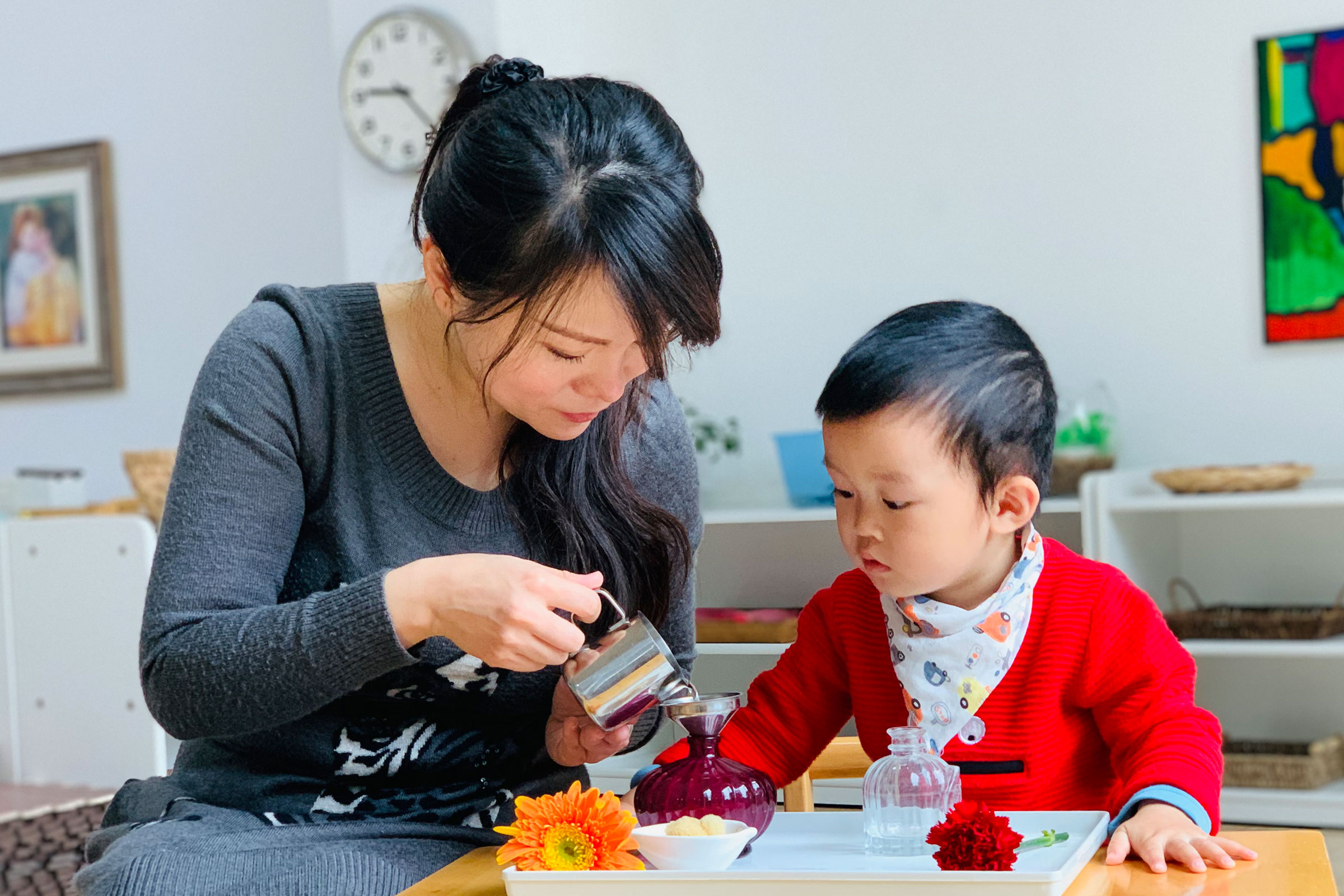
Firstly, our main role is to be a role-model for being human. We model kindness, connection, being present physically and psychologically, and offer clear communication – characteristics for supporting humans in various developmental stages.
Secondly, adults need to undergo a life-long reflection of coming to know who they are, what their biases and prejudices might be, what their reason is for wanting to work with children. The work as a Montessori trained adult is not just to know how to manipulate materials but must go deeper and this is usually a life-long evolving endeavour.
Thirdly, adults must study to understand the general development of children and then specifically the development of the children in the age group they will be working with.
Fourthly, adults, once they have created an exquisitely beautiful physical environment, must be willing to “give it to the children” and not become emotionally involved in taking ownership of the environment. It is an environment, lovingly created, but then given to the children. They are the ones who will use the environment for their own self-construction.
We do have the responsibility to maintain the beautiful integrity of this prepared environment. Nothing broken, missing pieces, or with chipped paint remains in the environment. It is removed until it can be repaired or replaced.
Montessori trained adults do not refer to themselves as teachers but as guides, guiding children along their personal journey of self-construction. This requires the adults to observe each and every child as all 3-year-olds are not the same, nor are all 4-year-olds, all 2-year-olds, all 8-year-olds. Our approach is individual, but individual within a social unit. No matter the age of the group of children, they are living and functioning in a social environment which has certain rules.
The primary rule is: “You may do nothing to harm others, yourself or the environment.” Children are given freedom to move, to interact, to discuss, but this freedom is always accompanied with limits, discipline, responsibility. Montessori trained adults find that the children in a group fairly quickly come to understand the one rule and accept it.