Movement and Sports
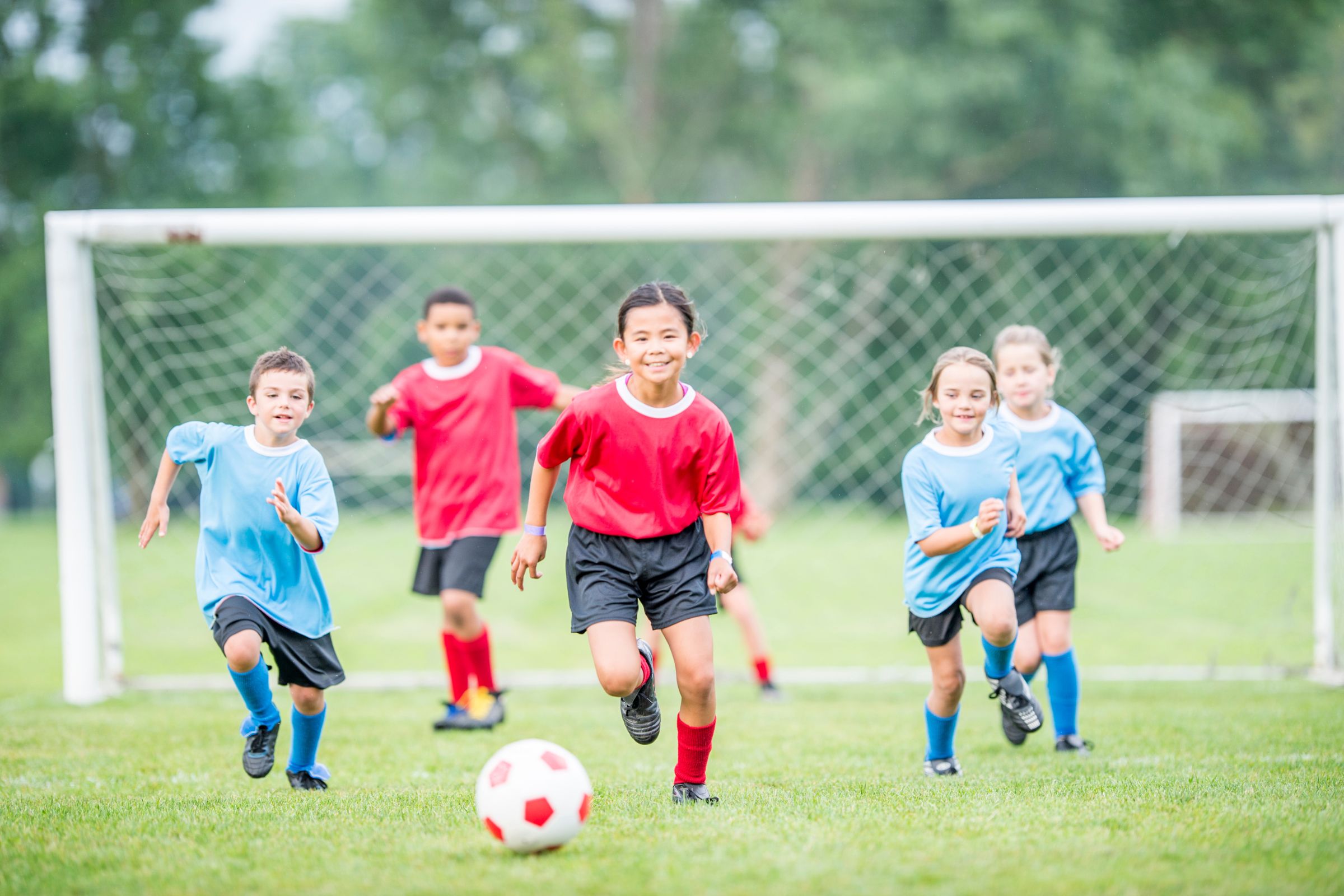
"There is another aspect of the school garden meant for amusement and instruction. It is the court and the lawn. Courts are meant for play. There should be a hard court, like the tennis hard courts, but larger and wider. Around this there should be a track for the children to walk around or run or go around on bicycles, scooters—it is something like a racetrack. On this track can be practiced roller-skating, ball play, skipping, pulling wheelbarrows and carts for transporting garden material or the children themselves galloping about for the sheer fun of it, playing the horse, and many other activities can go on both on the court and on the track.
Around this is the lawn. Here the exercise for equilibrium of walking on a beam raised one foot above the ground could be provided for. On one side of this court, on the lawn, can be built up a stepped pyramid. Pairs of steps, each six to nine inches high and deep, and a platform can be arranged in succession up to six or seven layers of steps. Lines should be drawn to guide the steps of the child in walking up and down. This guided walking gives special exercise for grace of comportment."
Maria Montessori | The House of Children, Lecture, Kodaikanal, 1944, p. 19
“In the schools, only certain gymnastics are done but the children are not allowed to do what they like and want to do. If we think that the future generation will be physically developed just by playing tennis, then we are sadly mistaken. People who are not allowed complete freedom of movement and who have to do sedentary work have created these playgrounds and these playgrounds are reactions to this passivity. The exercises of practical life are more suitable than gymnastics. The children’s movements are directed by the material and while the children are busy doing these exercises, the whole hall becomes like a gymnastics hall. These are practical and safe indoor exercises."
Maria Montessori | The House of Children, Lecture, Kodaikanal, 1944, p. 16
“Today these exercises are done in the open air, so that the child gets the benefit of the fresh air. Swimming and climbing—rope climbing and climbing trees—are not only exercises for the child but they also make him sure of himself and have a practical use. All these activities should be carried out in the open air. Jumping over heights and walking on narrow ledges are also enjoyed by the children. Children are not afraid of anything. We must observe what the children do—sometimes the most dangerous things such as hanging onto moving cars, etc.—we should try and help the child in doing these things and not intimidate him. We should prepare the environment for the children of the future. Children love escalators in spite of the fact that they fall down on them quite often. The tendency of the adult is to stop the child from doing these “foolhardy” things."
Maria Montessori | The House of Children, Lecture, Kodaikanal, 1944, p. 16
“Gymnastics, as they are taught today, are only necessary for children who are in closed environments and not for the children who are set free."
Maria Montessori | The House of Children, Lecture, Kodaikanal, 1944, p. 15
“External environments, such as gardens and games — these also vary according to the climate. In Holland, where the winter is prolonged and where there is a great deal of ice and snow, ice-skating is very important as a pastime. Ice-skating has to be taught to the children. Gymnastics also change according to the country. These exercises have become so interesting and exciting for the children that special halls have been built in order to teach these sports to the children (skiing)…. It is the environment that creates the sport and the gymnastic ability, and agility takes different forms. In Holland, in order to go from one place to another they skate or go on bicycles — even the children of three or four years. [...] Exercise ought to be for adaptation to the environment."
Maria Montessori | The House of Children, Lecture, Kodaikanal, 1944, p. 15
“We, ourselves, have these cycles of activity without a useful purpose. English sport is like this as it seems to serve no useful external aim. Sport is not played merely for the sake of competition; it is an exercise. We must give the child opportunities for this kind of play instead of useless play. Just as we have to prepare a special environment for sport, like a tennis court if we are to play tennis, the child must be given the means for this kind of exercise which is necessary for his life. It is essential that the small child has the opportunity for movement. The purpose behind this cycle of activity is not only to become strong, but also to acquire ability. The purpose of sport is to make us stronger and more able.”Maria Montessori | The 1946 London Lectures, Lecture 16, “Spontaneous activity”, p. 120
“If the child had no opportunities for activity, the different organs, which have been developed separately, remain separate. They do not become united; there is no unity of the personality. We see the intelligence acting without purpose, darting here and there without purpose. Movements are equally without purpose, mind and body are not correlated. Movement is not correlated with purpose. Intelligence is separate from movement. Children who cannot utilize coordinated movements for an intelligent purpose destroy everything. They break things because the active muscular movement and the mind are not connected. If later the individual is to be able to act with purpose in the environment, all his capabilities must have been fused together. They must act together in unity. Intelligence and movement must act together.”Maria Montessori | The 1946 London Lectures, Lecture 19, “The most important age”, p. 139
“The movement of animals is hereditary but man’s movements are not hereditary. Man constructs his movements for himself.”Maria Montessori | The 1946 London Lectures, Lecture 22, “Movement and Character”, p. 158
“The muscles are the servants of the will. These special muscles are called voluntary muscles. The purpose of the will is to move these muscles in coordinated fashion. […] The brain and the muscles are man’s speciality. Without hereditary movement, man must have a guide; his movements have not been determined for him. Thus, the construction of movement is an important part of a child’s development—not just a coordinated movement, but movement with a purpose. Coordinated movement must be involved with something great, and must be directly connected to the brain and the intelligence. There is a correspondence between intelligence and movement that brings unity.”Maria Montessori | The 1946 London Lectures, Lecture 22, “Movement and Character”, p. 158
“Their bodies are not important just for movement, but for movement with a special aim. Everyone must develop his or her body to be a perfect machine prepared for a special aim.”Maria Montessori | The 1946 London Lectures, Lecture 22, "Movement and Character", p. 160
“We see the child who is freely active change in character. Movement is correlated with character – just with intelligence, but also with character.“Maria Montessori | The 1946 London Lectures, Lecture 22 "Movement and Character", p. 160
“We try to develop the body in a gymnasium. This is not a natural way. It is not movement with an intelligent purpose. It is movement of different parts of the body at the command of another. We give physical education because we think that movement can facilitate function. This is an error. It is treating the body as though it were decapitated—dead—and moving it as we would a mechanical machine. You have no right to do this, because movement is a part of life. Life has a guide.“Maria Montessori | The 1946 London Lectures, Lecture 22, "Movement and Character", p. 160
“You have no right to order children to do gymnastic exercises, to order exercise to be done to commands and time. This method may break the personality and it will not perfect movement. The perfection of movement is spiritual. It is something that aids the development of the whole personality. Gymnastics are useless and dangerous, especially to little children who are in the period of constructing their personalities.”Maria Montessori | The 1946 London Lectures, Lecture 22, "Movement and Character", p. 161
“So, the conclusion is not that we should have gymnastic apparatus and a gymnasium in our Montessori schools, but we should have work. We can have a gymnasium and we can do anything we like with the muscles, but we must first realize the importance of movement.“Maria Montessori | The 1946 London Lectures, Lecture 23, "Hands", p. 165
“One of the greatest mistakes of our day is to think of movement by itself, as something apart from the higher functions, … we take exercise or do gymnastics, to keep ourselves “fit”, to make us breathe, or eat or sleep better. It is an error, which has been taken over by the schools. In the world of physiology, it is just as though a great prince were being made the servant of a shepherd. The prince—the muscular system—is only being used to help the vegetative life.”Maria Montessori | The Absorbent Mind, p. 151
“Such a grave error cannot but lead to injury: there comes about a separation between the life of movement and the life of thought. Since the child has a body as well as a mind, we feel we must include games in his curriculum, so as to avoid neglecting any part of nature’s provisions. But to be always thinking about the mind of the one hand and the body on the other, is to break the continuity that should reign between them. This keeps action away from thought. But the true purpose of movement is far higher that to produce an appetite or strengthen the lungs: it is to serve the ends of existence, the universal and spiritual economies of nature.”Maria Montessori | The Absorbent Mind, p. 151
"Tennis, football and the like do not have for their sole purpose the accurate moving of a ball, but they challenge us to acquire a new skill -something lacking before—and this feeling of enhancing our abilities is the real source of delight in the game"Maria Montessori | The Absorbent Mind, p.164
“What should our attitude be towards ordinary gymnastics and games in the open air? They are a means of using up excessive energy, that is, energy not yet expended. There should be a carefree use of the forces which the daily order of work has not used up. This is something quite different from looking upon games and gymnastics in themselves as merely a means of physical exercise, as a kind of reaction to the dangers of inertia.”Maria Montessori | The Discovery of the Child, p. 97
"Much is said today of the moral advantages of sports… because organized games, and this is most important, demand an exact use of object and consequently concentration and a complete control of one's movement. Games thus lead to a feeling of rivalry and animate a participant with a spirit of competition. And this, in comparison with aimless play, represents moral progress. "Maria Montessori | The Discovery of the Child, p. 97
“But the demands of practical life share in these advantages, for example exactness in the use of objects, the focusing of attention and the ultimate perfection attained through movements. The moral object however, is different since these exercises are not prompted by a feeling of rivalry or accomplishment but by a love of the children for their environment. All of us, and not simply children, should exercise our muscles by working and choose this kind of activity as the primary and most natural way of expending our energies.”Maria Montessori | The Discovery of the Child, p. 97
“Not long ago outdoor sports were introduced in order to provide physical exercise for the young people who were leading shut-in, sedentary lives; so, today, there is a need for a more dynamic training of character and the development of a clearer consciousness of social reality.”Maria Montessori | From Childhood to Adolescence, p. 58