Today’s children spend far more time in front of screens than previous generations. Many can navigate a tablet or smartphone with ease yet may have far fewer opportunities to climb a tree, dig in the soil, or watch plants grow.
Their attention is increasingly drawn into fast-moving digital environments, while the slower rhythms of the natural world play a smaller role in their daily lives.
A common response to this change has been to introduce occasional “nature activities” or outdoor lessons. Yet, Maria Montessori offered a much deeper insight nearly a century ago.
In The Discovery of the Child, she wrote: “A child needs to live naturally and not simply have a knowledge of nature.”
This simple statement challenges a common misunderstanding. Nature is often treated as something children can learn about through pictures, books, or videos. But Montessori observed that the child’s development depends on direct experience with the real world. Children do not develop a relationship with nature by learning facts about it. They develop that relationship by living in it.
The Absorbent Mind and Experience
In The Absorbent Mind, Montessori described the young child’s mind as one that does not simply receive information passively. Instead, they absorb impressions from their environment and gradually construct themselves through these experiences. For this reason, the environment in which the child lives is not simply a background to development — it actively shapes the child’s mind, movement, and understanding.
Montessori repeatedly emphasised that young children learn through movement, the senses, and direct experience. They need to touch, explore, manipulate, and observe the world around them.
Recent research in developmental psychology and neuroscience helps explain why these experiences are so important. When children explore natural environments, they encounter a rich range of sensory experiences — the texture of soil, the movement of water, the smell of plants, the sound of the wind. These varied experiences stimulate multiple sensory systems and support the development of neural networks in the brain.
Natural environments also support the development of attention. Researchers studying what is sometimes called attention restoration have found that time spent in nature can help children recover from mental fatigue and support sustained concentration.
This is particularly important in the digital age. Many digital environments are designed to capture attention quickly and repeatedly. Natural environments, by contrast, invite a slower and more sustained form of attention — the kind of deep engagement Montessori described when she observed children becoming absorbed in meaningful activity.
Montessori’s Observations of Children in Nature
Montessori made a striking observation about children’s relationship with nature. She noticed that in the city a child might complain of fatigue after only a short walk. Yet, when the same child is in a natural environment, even a very young child may walk long distances without tiring. The difference, she suggested, is not simply physical. Nature stimulates the child’s curiosity, movement, and interest in a way that artificial environments often do not.
Montessori also reflected on how modern life can distance human beings from nature. She wrote: “Civilized man is a kind of contented prisoner.”
In our efforts to protect ourselves from discomfort, we close windows, avoid weather, and limit children’s contact with the natural environment. Gradually we separate ourselves from the very world that sustains life.
Montessori warned that when children are separated from nature for long periods, something important in their development may be lost. She described this as a kind of alienation from nature. However, she also emphasised that our relationship with nature can be cultivated through experience: “Like everything else, a feeling for nature grows with exercise.”
In other words, a love of nature does not simply appear automatically. It grows through repeated opportunities to interact with the living world.
The Garden in Montessori Education
For Montessori, contact with nature was not simply an enrichment activity. It was an essential part of the child’s environment. In a lecture given in Kodaikanal in 1944, Montessori spoke about the importance of the garden in the Children’s House. She emphasised that the garden should not be decorative but meaningful for the child.
Several principles emerge from her observations.
First, the garden should be at the child’s scale.
The aim is not to create a large or impressive space, but a place where children can come to know every plant and develop a relationship with the environment around them.
Second, gardening should involve real work.
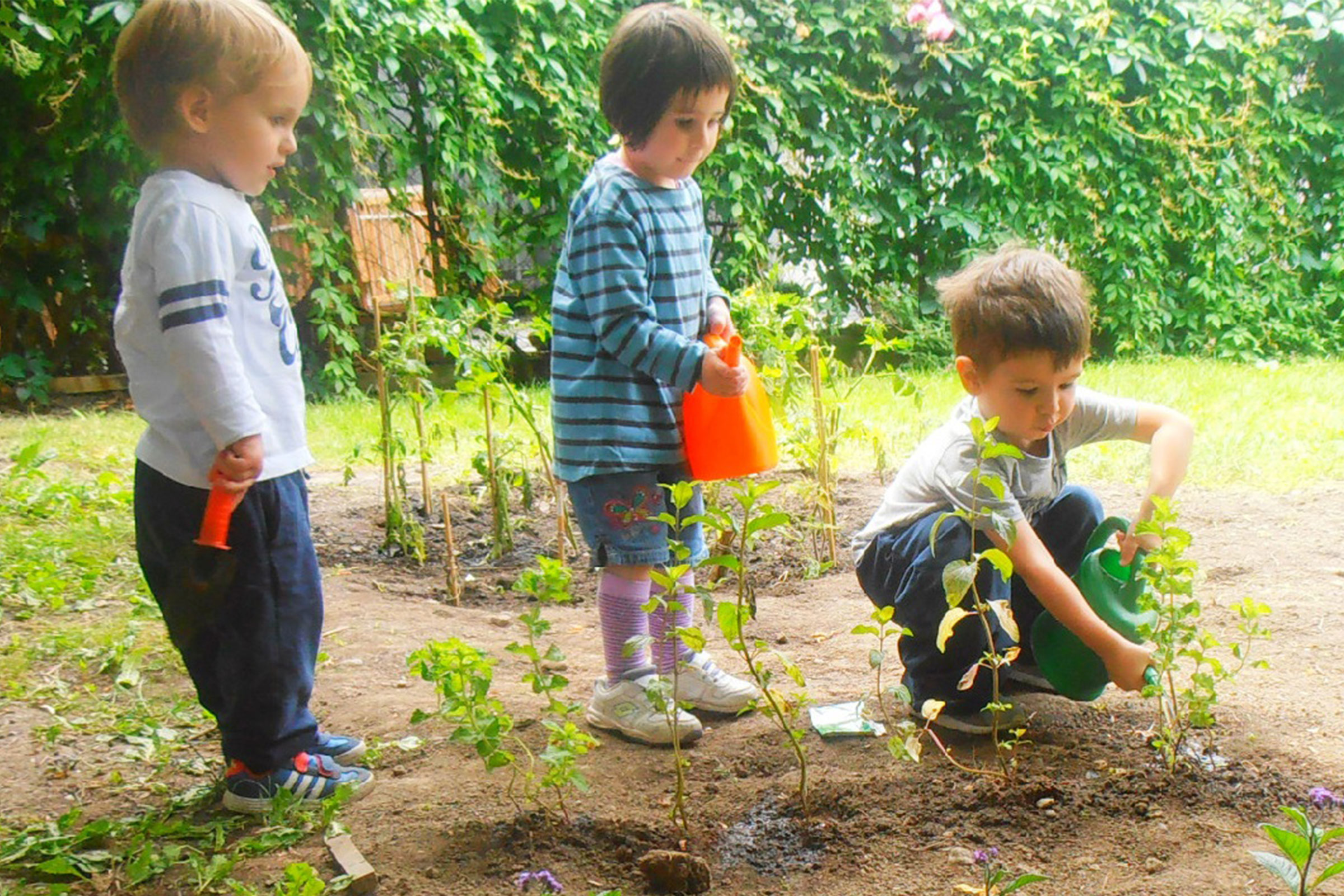
Children can participate in planting, watering, weeding, and harvesting. These shared activities give the work real meaning and allow children to contribute to their community.
Third, the garden should have a practical purpose.
Montessori often suggested growing vegetables as well as flowers. When children see that their work produces food that can be eaten, the activity becomes deeply meaningful.
Montessori also noticed that children are often particularly fascinated by the harvest. Adults sometimes assume that children will be most interested in planting seeds. Yet seeing the results of growth naturally leads children to ask questions about how that growth occurred. Experience leads to curiosity, and curiosity leads to learning.
Nature and the Development of Responsibility
Montessori also observed that contact with nature awakens an important moral quality in the child.
When a child cares for a plant, they quickly learn that their actions have consequences. If a plant is not watered today, it may suffer tomorrow. Montessori wrote that few experiences do more to awaken foresight and responsibility in young children. In this way, caring for living things helps children begin to understand the relationship between their actions and the future.
Nature in the Digital Age
Montessori’s insights feel particularly relevant today. In a world where children increasingly encounter the world through screens, direct experience with nature becomes even more important. Digital media can provide information, but it cannot replace the sensory richness of the natural environment.
A screen cannot replicate the smell of soil after rain, the texture of leaves, the movement of insects, or the changing light of the seasons. These experiences nourish curiosity, attention, and a sense of connection with the living world.
What This Means for Montessori Environments
For Montessori educators, the question is therefore not simply whether children have occasional “nature lessons.”
Instead, we must ask deeper questions about the environments we prepare.
- Does the outdoor environment truly belong to the child?
- Are there meaningful activities connected to nature that the child can carry out independently?
- Do children have sufficient time outdoors to build their own relationship with the natural world?
Montessori believed that through direct contact with nature children develop not only knowledge, but also care, responsibility, and respect for life. She wrote: “There must be provision for the child to have contact with nature; to understand and appreciate the order, the harmony and the beauty in nature.”
Nature has always been available to the child. The question for us today is whether we are willing to allow children to return to it — not as a special activity, but as a natural and essential part of their daily lives.
Angela Shang, AMI 3–6 Trainer