Experience, exploration and expression describe each period of the three-period lesson. While called a lesson, it is actually a technique primarily used in the 3–6 classroom to introduce new terms or vocabulary. It was first introduced by Seguin who is best known for his work with individuals with developmental delays. Finding it effective and simple, Montessori adopted this technique in her own work with children.
The three-period lesson consists of the following:
- 1st period: the teacher introduces the vocabulary, connecting it to a sensory experience (through sight, sound, texture, taste or smell).
- 2nd period: through various activities, the child explores and practices identifying the new terms.
- 3rd period: the child demonstrates their ability to independently express the name and use concepts accordingly (express).
If we take a closer look at this technique, we will see how it mirrors the broader three stage learning cycle used throughout Montessori education: Introduction (Exposure to Experience), Practice (Exploration), and Application (Expression).
The Montessori method of education for the young child is built on the principle that children learn best through hands on experiences and sensory exploration. As Maria Montessori observed long ago, cognitive development arises from the mind and body working in unison as they interact with their surroundings. This concept aligns with Aristotle's saying there is nothing in the intellect that was not first in the senses. Through the senses the child receives and processes information visually, auditorily, gustatorily, olfactorily and somatically. Visual processing allows one to interpret and understand what they see which is crucial for learning and navigating the environment. Auditory processing helps the child comprehend and remember sounds which is essential for communication and learning. The gustatory system enables the child to recognise and differentiate between basic tastes like sweet sour salty bitter and umami, contributing to one's eating habits and safety. The olfactory system, responsible for the sense of smell, plays a significant role in emotional response and memory information. Finally, somatic senses, including touch, helps the child explore the environment and develop motor skills. Together these sensory systems provide a comprehensive way for the child to interact with and understand the surrounding world. With this understanding, we can see how important it is for the child to experience their world in a sensorial way.
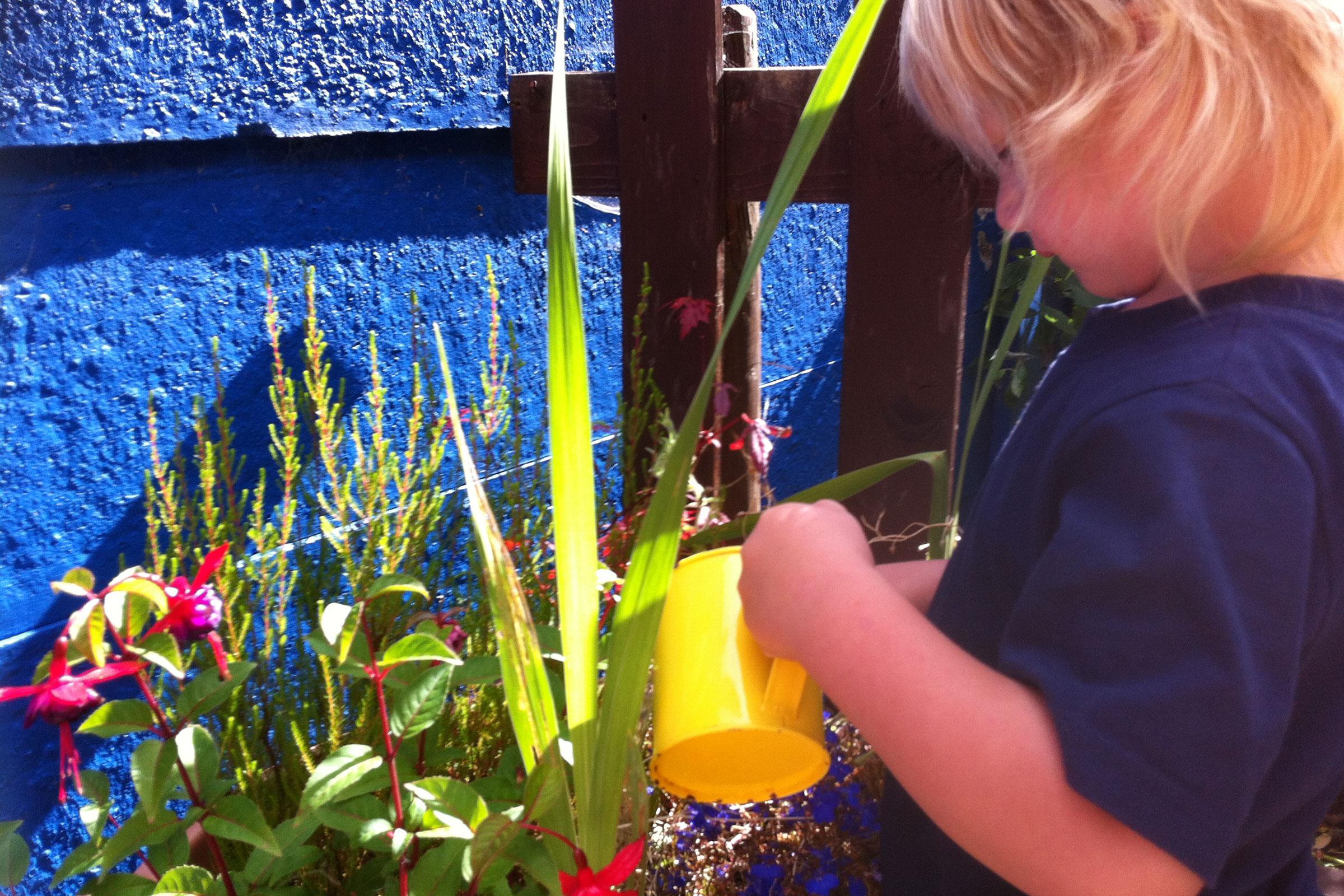
To facilitate this sensory based learning, Montessori classrooms are carefully prepared to be an environment rich with experiences. They are designed to provide multi-sensory experiences that can help form the foundation for later learning. For example, children might engage in activities like watering plants, washing leaves, or observing root growth, thus building a concrete understanding of plant life before formal lessons on botany begin.
In addition, the Montessori approach facilitates a natural progression from concrete experiences to abstract understanding. Again, using botany as an example, when learning about leaf shapes, children first interact with real plants, perhaps through a story or an observation which could include feeling the texture of different leaves or even experiencing their scents, such as with herbs. This hands-on experience makes later work with materials like the botany cabinet more meaningful and relevant. Similarly, involvement in plant care activities creates a foundation of real-world knowledge. When children later learn the formal names of plant parts, their definitions, and other more complex botanical concepts, they can easily connect this new information to their existing experiences. In this way, we can see how intelligence, which is the application of knowledge and skills, can develop with ease.
Montessori described intelligence as a house with four rooms. She said "Intelligence is like a house within which there are four apartments, each occupied by a certain entity. Each apartment has a door which opens out into an open place inside. We can call the entities Understanding, Reason, Memory, and Interest. Each of them has a special task in the house and work together in harmony to construct Intelligence. Usually, a stimulus knocks on the door of Memory. Then it goes to Understanding. If Understanding accepts the stimulus, it then goes on to excite Interest, and shakes him up. Interest goes with Understanding to call Reason. Thus, working together, they construct the Intelligence.” (Montessori, Creative Development of the Child).
Here is a quick summary: A stimulus (experience) causes neural activities in the brain that can create longer lasting memories that are also easier to access, therefore making one’s ability to reason (meaning to think and understand) much stronger.
This cycle emphasizes the importance of integrating all aspects of learning, rather than relying solely on memory. It allows children to embody facts through exploration and discoveries, not just rote memorization. What then is the role of the adult? It is not to teach, but to facilitate learning by preparing an environment rich with experiences and opportunities for exploration. Experiential learning in Montessori classrooms helps students connect theoretical concepts to real world situations (express) because of their experiences This holistic approach makes education seamless, enjoyable, and relevant to the child.
Caroline Aguilar Clark, AMI 3–6 Trainer