A Montessori environment is immediately recognizable as one enters it. We see beauty and order, colourful materials on open shelves, spaces for individual or small group work, bustling and concentration of the children, and the guide who recedes into the background. Special attention is given to the social and psychic aspects of the environment: those qualities pertaining to the soul or spirit of the child. Adults are seen as “guides,” harbouring a deep respect and love for the children, informed by observation, limiting their intervention and inspired to foster the children’s growing independence.
The Montessori prepared environment for the third plane is as unique, complex, creative, daring and challenging as adolescents themselves. Montessori refers to this environment as a “centre for study and work,” implying that it is not a school in the traditional sense. It shares the characteristics of beauty, order, space and functionality, understanding, love and respect while acknowledging the particular needs of the third plane. Adolescents are crossing the bridge from childhood to adulthood and are preparing to take their place in the greater society. So, we offer them an environment which demonstrates social organisation and fosters the ability to function as compassionate, informed, contributing citizens, who have developed a strong sense of self, are able to think critically and function independently.
Creating an environment for adolescents requires a true paradigm shift. The human tendencies on the third plane operate in the context of the prime directive of adolescence: to be social. Adolescents’ self-construction requires opportunities to explore the social and economic dimensions of the adult world to explore their identity, strengthen self-confidence and prove themselves as valuable contributors to society.
In From Childhood to Adolescents Montessori outlines her ideas of how study and work emerge in service of self-construction. She begins with the moral and physical care of young adults, those relationships among students, adults and the environment, emphasizing that, despite their not always congenial attitudes, the adolescent must be respected as a “becoming adult.” She insists that access to nature, a healthy diet, physical activity and places for solitude and contemplation be present in the environment.
Because their development is in the social realm, adolescents need to create, maintain, and evolve a society and social structure in which they have agency, and their ideas and decisions are the main impetus for work. It goes well beyond being together in a classroom. There must be structures that integrate moral, social, spiritual and cognitive development, fostering independence and interdependence. This is where their learning, moral development and sense of justice are rooted. We refer to this as social organisation.
Montessori proposes a physical environment that has five essential components: the farm or land, a residence, a shop, a guest house and a museum of machinery. These elements work together and are foundational to giving adolescents opportunities to develop socially in the context of meaningful, adult work.
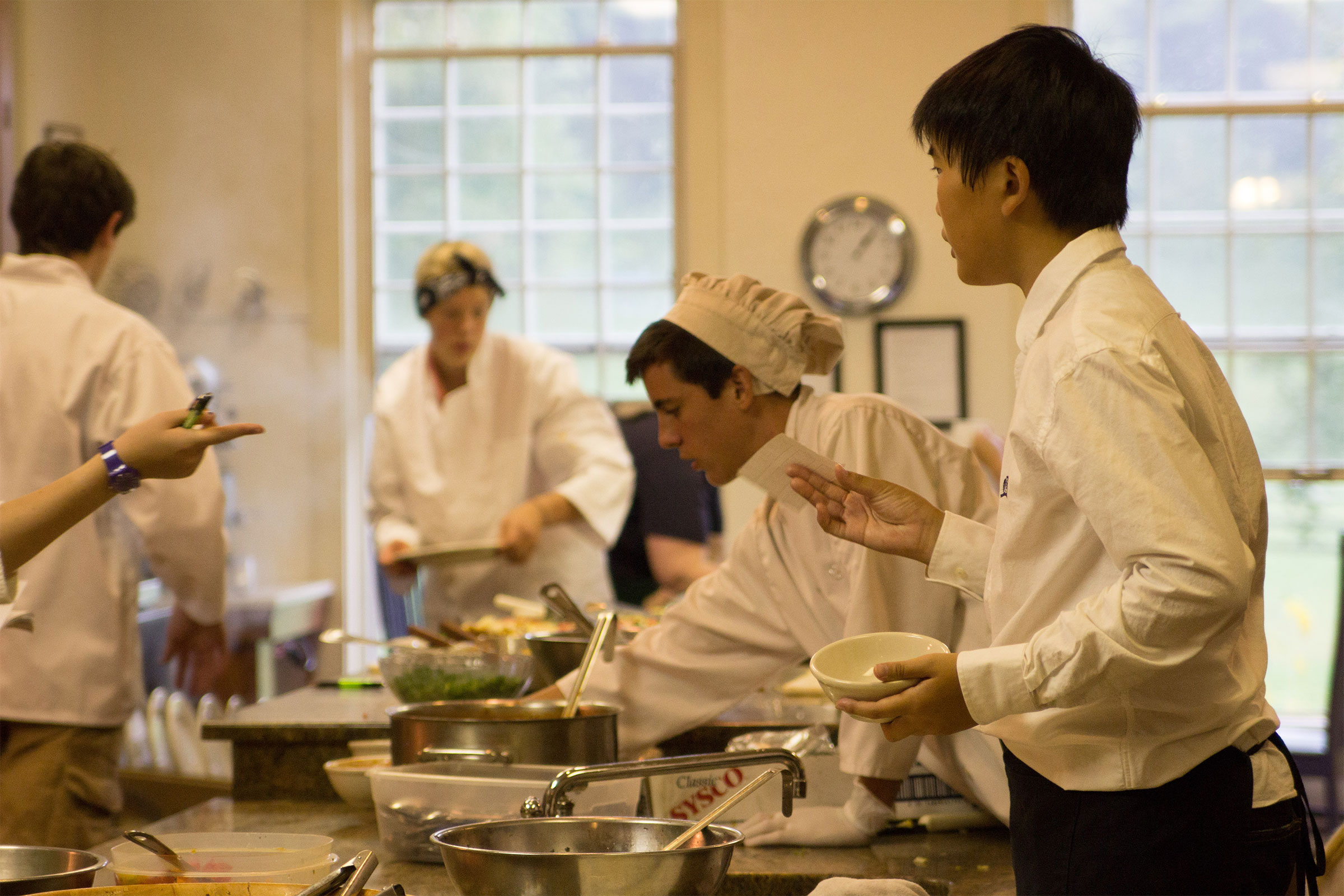
The residence can be seen as the heart of the community. Here the students fully share responsibility for the care of themselves and the environment. Meal planning, decorating and maintaining the environment – inside and out, proposing projects, and special events, scheduling activities, division of tasks – all are necessary to the development of independence in the context of interdependence. The interplay of the individual and the group provide opportunities for a continuous cycle of work, meaningful contribution and valorisation. Community meetings and seminars reflect an ethos of respect, active listening, and thoughtful problem solving that contribute to the development of a moral sense.
The plants and/or animals on a farm provide students with the ability to produce something useful and meaningful to support themselves or to be sold to the greater community. All activities conducted on the land are rich with potential to discover and apply biology, physics, mathematics, precise language, experimentation, observation, and historical studies. This work cultivates collaboration, empathy, compassion, responsibility and a safe, protected experience of logical consequences and learning from mistakes. It requires a connection to nature as a real, profound, daily experience.
Projects that arise from the farm and residence require big, meaningful, physical adult-like work. This cannot be emphasized enough. Not something done in a minute, or tokenistic. Big projects. Big ideas. Well thought-through, researched and investigated plans generated from the students’ interests. This becomes the focus of their daily activities, acquiring the skills and information they need to bring their ideas to fruition! The adolescent community will naturally reflect the time, place, customs and culture of the greater society.
The shop or store enables students to create and offer something of value to the school community, or the wider community, referred to as “production and exchange.” This participation in the economics of everyday life requires discussions of fair pricing and practice, bookkeeping, marketing, equity, and the impact of production on the environment. Genuine understanding of what goes into generating a product or creation to sell – costing of materials, the intimate knowledge of pouring oneself into the creation - are invaluable experiences for the adolescent.
We refer to the adults (plural) in a Montessori environment, for the diversity of activities and work requires generalists as well as specialists, regular staff, skilled in observation and knowledge of the needs of the adolescent and visiting experts. The number and skills of adults reflect the size, population and culture of the community itself. We describe adults as a material in the environment for adolescents look to them to model mature adult behaviour, both individually and as a collaborative team. Adults should never do what the students can do for themselves, and we often underestimate their potential. It may take training and patience, but the guides must stand back and allow adolescents to make mistakes. and be willing to live with those mistakes.
This is the key to the paradigm shift: We must create an environment in which adolescents are at the centre of the activity of the community - not the curriculum, parental demands or teacher expectations. The big, physical, adult-like work, and the learning that its implementation requires, the work that is foundational to their development, should be happening all the time, not for a couple of time slots a week. This work has its origins in the environment itself and, as adolescents mature at the 15-18 level, it broadens into the wider community in the form of internships, community involvement and projects outside the school, if we allow and encourage their own agency.
We can all aspire to have a farm, residence, store, or guest house, and, in the meantime, we can adapt the environment we have to the needs of the young adults. There are many creative ways to grow food, create useful products or serve the community. An extended camping trip can be an experience of community living as long as the students themselves plan, arrange transportation, maintain a budget, prepare meals and provide for mutual safety. The point is that they must see the environment, the work, the study as theirs, generated and belonging to them. This shift of focus requires faith and trust in adolescents, creativity, imagination, patience, time and, above all, courage.
Patricia Pantano, AMI 12–18 Trainer