I am an AMI trainer and Head of Training at the Maria Institute in London. I have spent the last 11 years studying educational neuroscience to doctoral level. The more I understand about how we learn the more convinced I am that our children deserve a different education to that which is currently offered. This is my “voice” on this subject – I encourage you to find out more about neuroscience and join me in what Montessori called “education revolution”.
What if the biggest problem in education isn’t rising levels of children with additional leaning needs, disenfranchised teachers, or funding? What if the problem is with the model itself?
For more than a century, mainstream schooling has largely operated on a template designed for an industrial age: standardised delivery of content, fixed pacing, undifferentiated for age or ability and passive intake of adult-designed and adult-led curricula. All reinforced by testing to assess that outcomes are being achieved. In 2023, Professor Angeline Lillard suggested that it is a system built to transmit information efficiently rather than cultivate minds effectively. She argued that the education system is now “long overdue an overhaul,” insisting that education needs a “paradigm shift” comparable to a scientific revolution (Lillard, 2023). There is nothing in her argument that the neuroscience of learning does not agree with.
Current neuroscientific understanding indicates that learning is not a single mental function but a whole-system working together. Sensory input, motor activity, attention, emotion, and encoding in memory operate together in a dynamic loop that builds neural connections in the brain (Thomas & Green, 2023). These connections support what we know, how we think, and how we act.
When this loop is repeated, neural connections strengthen. Over time, what was once effortful becomes automatic. When one element is missing, especially motor action or motivation, the loop weakens and the system breaks down making learning harder. However, when teaching supports these learning systems, learning becomes deeper, more efficient, and less stressful.
For this optimal learning, and for neural connections to be made and strengthened, the cognitive neuroscientist, Stanislaus Dehaene, suggest that several conditions are essential (Dehaene, 2020). First, attention must be engaged. The brain cannot learn information it does not attend to. Second, learning requires active engagement. Doing something and observing the result is far more effective than passively receiving information. Movement plays an important role in regulating attention and supporting cognitive processing. Far from being a distraction, physical activity can enhance focus and learning. Third, the brain learns by predicting what is most likely to happen and it becomes particularly engaged by an error in its predictions making error feedback an important learning tool. Finally, time and repetition are necessary for consolidation, allowing new knowledge to become integrated into the brain’s structure. The brain is not designed to sit still and absorb so why do we ask children to do this in school?
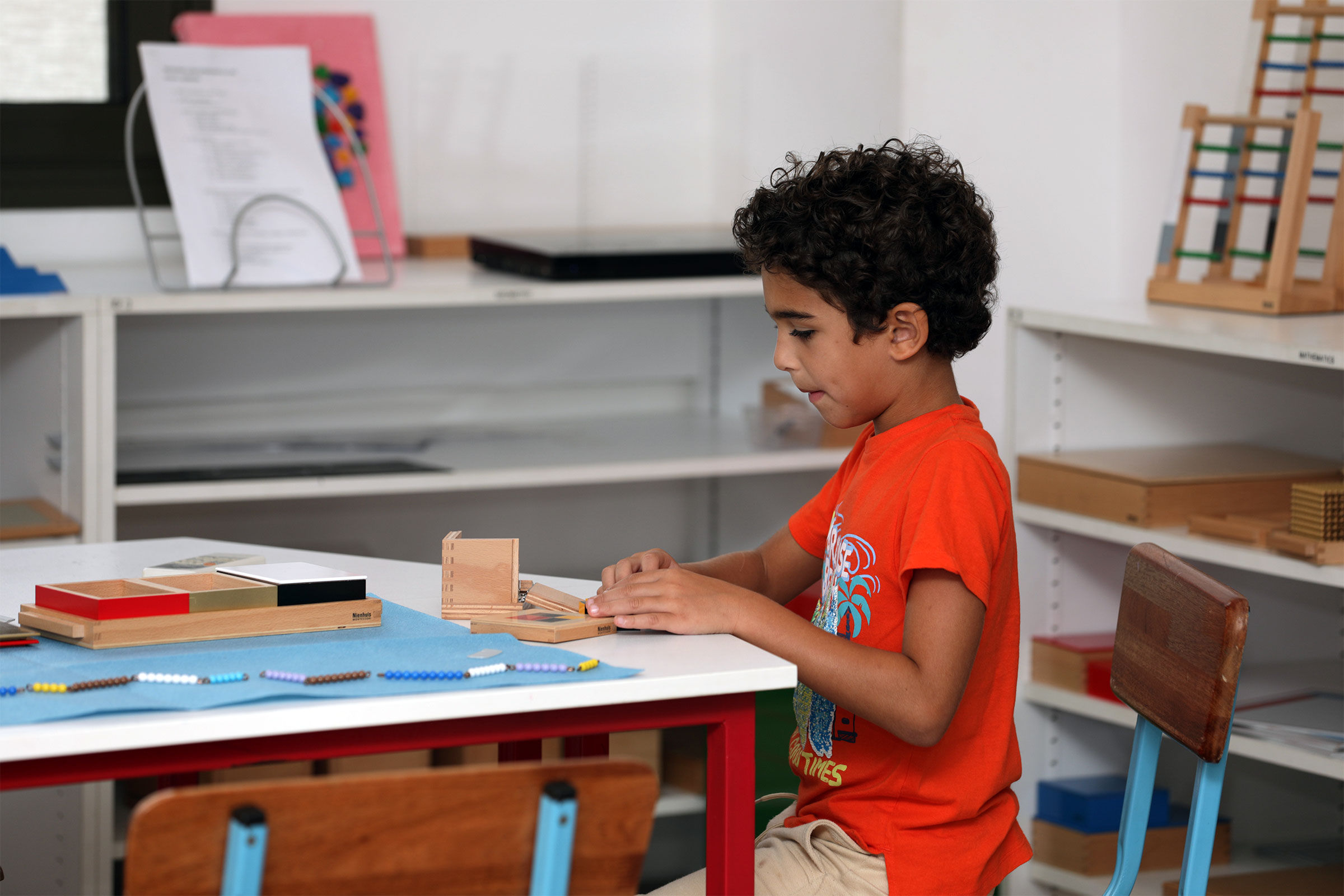
One educational environment that aligns with these principles is Montessori. Calm, structured, predictable environments help children to allocate attention efficiently because they are not constantly trying to interpret unexpected stimuli. This also reduces stress, which is important because anxiety interferes with attention. Autonomy and choice are equally important to reducing stress. When children can select activities that match their interests and developmental level, emotional relevance signals to the brain that something is worth remembering. But when emotion signals that something might be too stressful for them attention is diverted to the survival instinct of reducing stress and attention to learning is difficult. So, getting the balance between emotional engagement and unhelpful stress is crucial to learning. This is a functional component of learning as it offers opportunities for sustained concentration, that are crucial. When children are interrupted frequently, the learning loop is broken before it has really got started.
The integration of movement into cognitive activities is also central to attention and active engagement in learning. Learning is strengthened when children manipulate objects, move their bodies, and interact physically with materials. This is because cognition is not confined to the brain alone - it is distributed across brain, body, and environment. Since physical interaction provides sensory and motor information that enriches neural encoding and supports memory, concepts that are experienced physically often become more deeply understood than those encountered only verbally.
Another key factor is error feedback. The brain learns efficiently when it can detect and correct errors. Immediate, clear feedback helps refine neural pathways and prevents misconceptions from becoming entrenched. Further, when environments treat mistakes as failures to be corrected children become de-motivated and feel less competent (Sierksma & Brummelman, 2025) but when making mistakes is treated as a natural part of learning this encourages experimentation, persistence, and adaptive thinking. Children feel safe to try, fail, and try again, and they remain engaged in the learning loop. Recent research demonstrated that Montessori students showed greater neural engagement following errors, suggesting they may be more attuned to learning from mistakes than those in mainstream environments (Denervaud et al., 2020).
Consolidation is aided when repetition is encouraged through the careful sequencing of materials. The brain does not learn in leaps - it builds understanding layer by layer. Neural networks form by linking new information to what is already known. When foundations are secure, learning accelerates. When they are not, later knowledge has nothing stable to attach to - and begins to collapse.
Educational approaches that align with these neuroscientific principles tend to foster strong executive functioning. Executive skills such as attention regulation, inhibitory control, and working memory, are essential for goal-directed behaviour and independent learning. They develop through repeated opportunities to focus, plan, monitor progress, and adjust strategies – that is, through opportunities for attention, active engagement, error feedback and consolidation. Environments that provide such opportunities are effectively training the brain’s control systems alongside academic skills.
If learning depends on integrated brain systems, then environments that fragment attention, restrict movement and choice, and prioritise performance metrics over engagement are not neutral. They are misaligned with how the brain functions and the key to thriving. When these systems operate together, children do not simply acquire information, they develop the capacity to think, adapt, and solve problems. Education then becomes not just a process of knowledge transmission but a process of brain development. This perspective has important implications for how we evaluate educational success. The question is not only whether children can recall information, but whether they can use it. True learning is demonstrated when knowledge can be applied, transferred, and adapted to new situations. This kind of learning depends on the integration of cognitive, emotional, and sensorimotor processes.
Put succinctly, Montessori works with the brain rather than against it. When schooling aligns with brain development, outcomes extend beyond academic scores. Students tend to show stronger academic, executive, and socio-emotional outcomes (Demangeon et al., 2023; Lillard et al., 2025a; Randolph et al., 2023) These capacities support lifelong learning and well-being as adults (Lillard et al., 2021; 2025b).
In a world, where the future is unpredictable and information is constantly changing, these capacities may be more valuable than any specific set of facts. Yet education reform debates often focus on curriculum tweaks or new assessment systems. But if neuroscience is right, the problem is structural and requires more than a tweak. We have spent generations trying to improve a system built on outdated assumptions about how learning works. Adding technology, revising standards, or increasing testing changes little. They simply try to compensate for assumptions that neuroscience now tells us are flawed.
Prioritising emotional and social development alongside academics is not a luxury but a necessity if societies want mentally healthy, capable future citizens. We now know far more about how children learn than we did when most school systems were designed. We understand neuroplasticity, motivation, embodied cognition, and developmental timing. We have data linking educational environments to brain organisation, wellbeing, and lifelong outcomes.
The question is no longer whether neuroscience should inform education. The question is why it hasn’t already. Calls for educational transformation are often dismissed as ideological. Neuroscience reframes them as empirical. So, the real question is
If we know how the brain learns best, why are we still teaching as if we don’t? Let’s put our voices together to strengthen the call for an education revolution.
Louise Livingston, AMI 3–6 Trainer