One day, one of my nieces was drawing at home and asked me how to "draw" a Hanzi. She had seen Hanzi on street signs, on television, and in print. Often, when people learn Hanzi for the first time, they imitate what they see.
Since the unification of the Small Seal Script during the Qin Dynasty, Hanzi has been the dominant form of Chinese language representation. Consequently, Hanzi became standardised, implementing uniform rules.
Hanzi possesses the following characteristics:
- All characters represent morphemes and have meanings.
- Foundational strokes arranged in a square space. Stroke order matters.
- Around 80% of the Hanzi are semantic-phonetic compounds.
The Hand, The Companion of the Mind
Dr. Maria Montessori said “It is thanks to the hand, the companion of the mind, that civilization has arisen. The hand has been the organ of this great feature that we inherit.” She also said, “Hands are the instruments of man’s intelligence.” Handwriting is an intellectual work which requires training for the writing hand and the brain.
By indirectly preparing the child through multiple layers, we take advantage of the child's absorbent mind before elementary school.
Handwriting involves various types of movements:
- Tripod pincer or pencil grip: The thumb, index, and middle fingers are used for writing. This is particularly important for controlled movements in a small area.
- The wrist: The whole hand needs to pivot at the wrist for smoother and more fluid writing.
- The arm: The forearm rests on a surface, anchoring the wrist and the hand so that larger strokes can be made.
Aspects of Indirect Preparation
In the Practical Life area, the child is required to utilise their hands extensively. The dressing frames, with their various fasteners such as buttons, hook and eye, zipper, buckles, and bows, all serve to reinforce the use of a tripod pincer grip, albeit one different from the pencil grip. These activities are excellent indirect preparations that promote finger dexterity and the collaboration of the thumb, index, and middle fingers. The fingers do not operate in isolation when manipulating the dressing frames. When the child engages with this work, they are seated at a table. Their elbows will naturally rest on the table while their fingers manipulate the fasteners, which inherently necessitates the use of the wrist.
The hand is further prepared for writing through some activities, even though they are still indirect preparations. Table washing is one of them. Circular motion is used when scrubbing. We use smaller circular motions on the edges of the table. When scrubbing the centre of the table, we use a larger circular motion. While standing, the entire arm, wrist, and hand are coordinated. When writing on a larger surface, a Chinese calligrapher will stand in order to create a larger Hanzi.
The polishing of metals, mirrors, and wood is another activity. When polishing an object, the child will sit at a table. Objects are smaller than tables. During polishing and buffering, small circular motions are used. They will rest their elbows on the table. This will require more wrist movement. Whenever we write on paper at a table, we use very similar movements.
In the Sensorial Area, there are also several opportunities and even more particular indirect preparation for the writing hand. Several materials are designed with knobs. One of them is the cylinder blocks. The knobs on the cylinders are small. We need to hold the knobs with tripod pincers. The puzzle maps have even smaller knobs and require more sophisticated finger dexterities.
Sensorial materials, such as the rough and smooth boards and the touch boards, encourage the child to practice applying a gentle touch to sandpaper surfaces using either four or two fingers. This exercise cultivates the lightness of touch required for handwriting.
The geometry cabinet and leaf cabinet further advance the indirect preparations for handwriting. When a child grasps a geometric shape for tracing, employing the index and middle fingers of the dominant hand, they exercise lightness of touch, controlled movement, and steady adherence to the contour. Conversely, tracing a leaf shape involves holding a stick with a pencil grip and tracing in the same manner as the geometric shapes.
Onward to Writing
In the language area, the metal insets are introduced. The child traces the metal shapes with a pencil and fills the shapes using a controlled, up-and-down stroke with lightness of touch, moving from left to right. This process, rather than requiring elementary-aged children to copy Hanzi stroke by stroke, allows for self-perfection in writing without the direct act of writing, as evidenced through the metal inset exercises.
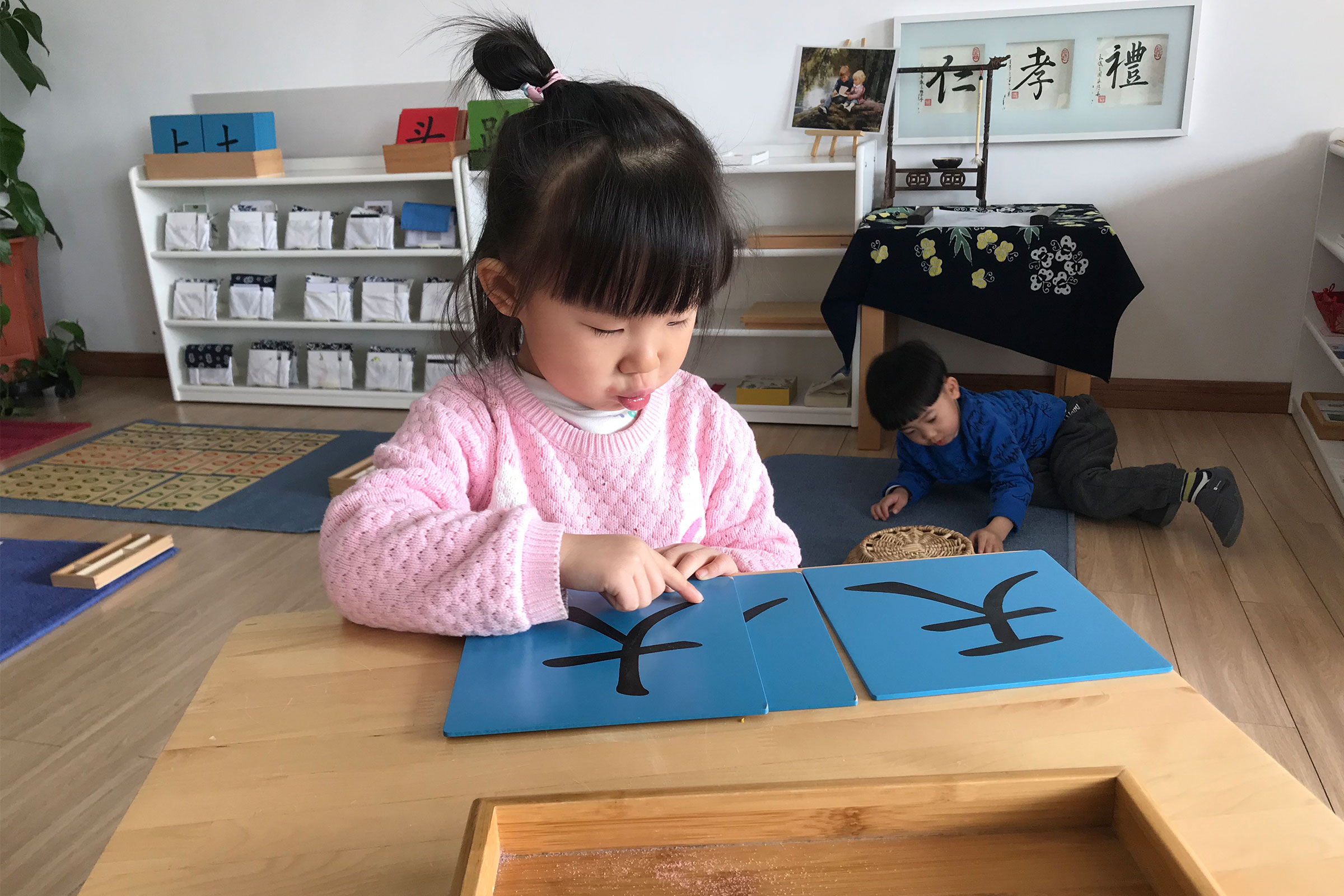
Hanzi are logographs comprised of strokes arranged in a specific sequence. For a child to successfully write Hanzi, initial recognition is a prerequisite. Drawing inspiration from Dr. Maria Montessori's use of sandpaper letters for alphabets, sandpaper Hanzi is employed in Chinese education. Sandpaper Hanzi facilitates visual, tactile, and muscular engagement. Concurrently, while tracing the sandpaper Hanzi boards, the complete morpheme is presented. The ordered sequence of tracing, following the established stroke order, becomes integrated into muscular memory.
"Writing is a complex act which needs to be analysed. One part of it refers to motor mechanisms, while the other represents a true and proper effort of the intellect." As a Chinese proverb states, "A craftsman who wishes to do his work well must first sharpen his tools." If the child’s hands and mind are adequately prepared, the child will discover their capacity for writing. This serves as an excellent illustration of the efficacy of Dr. Maria Montessori’s indirect preparation approach.
Teng-Chien Yu, AMI 3–6 Trainer