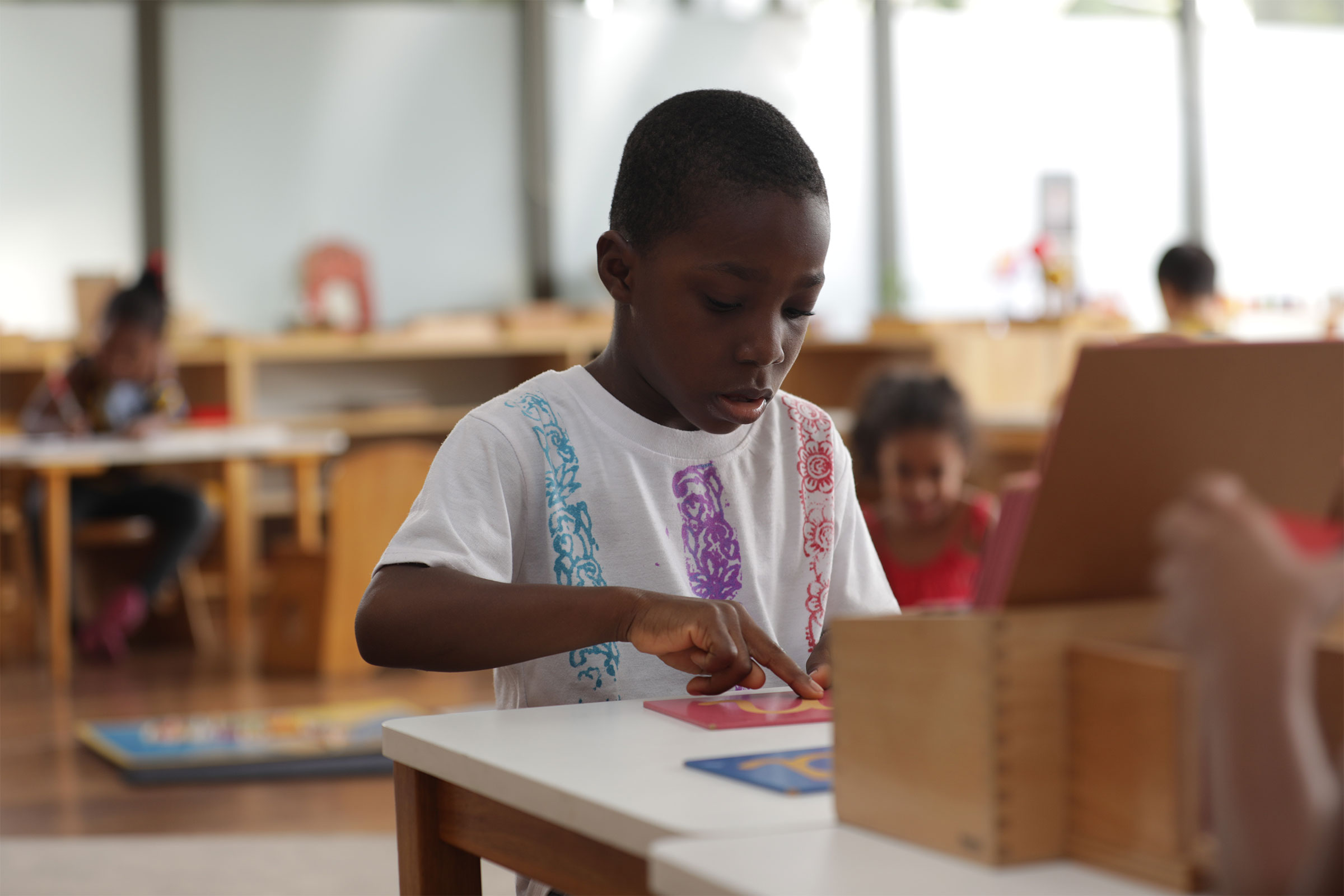
Language development in early childhood is a fundamental process that influences all areas of learning and socialisation. In the context of the Montessori method, this process takes on even greater importance, as it aims to foster an environment that stimulates the natural acquisition of language, promoting effective communication, comprehension, and expression in children between the ages of three and six.
Importance of Language in Early Childhood
Language is not only a tool for communication, but also a means to explore the world, express emotions, develop cognitive skills, and form social relationships. At this stage, children begin to expand their vocabulary, understand grammatical structures, and use language to interact with their environment and with others.
From a neuroscience perspective, language development at this stage is associated with the maturation of specific brain areas, such as Broca's area and Wernicke's area, which are responsible for language production and comprehension, respectively. Brain plasticity at this early stage allows linguistic experiences to have a lasting impact on brain structure and function, facilitating more effective and lasting learning. Exposure to an environment rich in linguistic stimuli promotes the formation of neural connections that facilitate language acquisition and other cognitive skills.
Furthermore, neuroscience has identified that social interaction and active communication are essential for the development of brain areas related to language.
The Montessori Environment and Its Influence on Language Development
In the Montessori method, social interaction, the use of appropriate materials, and the child's active participation in linguistic activities are fundamental to enhancing their cognitive and linguistic development. It is based on a prepared environment that fosters autonomy, exploration, and active learning. The fact that a child can already speak does not imply that their language development is complete or perfected. To enhance language development, this environment includes:
- Sensory and educational materials that stimulate observation and description.
- Age-appropriate books that encourage storytelling and comprehension.
- Guided conversation activities that promote oral expression.
- Spaces for social interaction that facilitate communication.
Interaction with specific materials, such as vocabulary cards, movable letters, and sorting objects, helps children associate words with concepts and objects, strengthening their vocabulary and comprehension. We want to show them that, just as we express ourselves orally, we can also express our ideas, feelings, experiences, etc., in writing, and that there are special symbols (letters) that help us communicate with others without necessarily being near them. Later, they will be able to discover what others think through reading.
“What I think I can write down,” and also, “I can know what others are thinking without them having to speak.” “Reading is silent communication!”
It is important to understand our role as adults in this process not as the one who “teaches,” but as the conduit that offers the child the necessary tools so that they can arrive at what Maria Montessori called the “explosion” into writing and reading.
Language is something that must be “alive” in the environment. Having conversations with children, giving clear instructions, singing, playing with words, saying tongue twisters, riddles, telling stories, reading books, etc. We need to offer these tools with great joy, through games that help them explore the words they use every day.
Many of the exercises in the language area are like “games.” Isn’t the three-period lesson a game for building vocabulary? Isn’t the movable alphabet a medium where the child can express their ideas with the symbols and sounds they know? Didn't we begin reading with the first box of objects as a way of "playing" to see if we can decipher what the other person is thinking? Aren't word function exercises a series of "games" that help children realise that the words we use have a specific function and order so we can communicate better?
All these exercises are primarily an opportunity for children to explore the language they use in their daily lives and, at the same time, enrich their vocabulary.
Suggestions for enriching language in children aged 3 to 6
To support language development at this stage, it is recommended to implement various strategies in the everyday environment:
- Daily reading: Read aloud with a variety of books, encouraging participation and repetition.
- Meaningful conversations: Talk with children about their experiences, interests, and emotions, promoting expression and comprehension.
- Word games: Rhyme games, riddles, and tongue twisters that stimulate phonological awareness and the recognition of linguistic patterns.
- Vocabulary expansion: Introduce new words in relevant contexts and explain their meaning simply.
- Creative activities: Encourage storytelling, dramatization, and poetry, which develop imagination and verbal expression.
In conclusion, language development in children aged three to six in a Montessori environment is an enriching process that combines appropriate stimulation, social interaction, and the use of specific educational materials. Understanding the relationship between language and neuroscience underscores the importance of creating environments that foster brain plasticity and natural learning. Implementing varied and meaningful strategies in daily life helps develop communicative, confident children with strong cognitive skills, laying the foundation for future learning success. After all, we are not just helping children learn to read and write, but helping them develop their personalities!
Cristina A. De Leon, AMI 3–6 Trainer