This paper is based on studies that analyze these concepts from a physiological and psychological perspective, focusing on children from 3 to 6 years old.
1. Definition of Will and Its Importance
Will is understood as the ability to act with intention and purpose, closely linked to consciousness. It is the force that allows children to make decisions and direct their actions towards what they want or need.
Unlike simple inhibition (stopping an impulse or not doing something), the will also includes the initiative to act. It is not only to contain oneself, but also to choose, to start and to sustain an action. Thanks to willpower, children begin to relate to their environment more consciously and to actively shape their own development.
2. Executive Functions and Their Development
Executive functions are a set of cognitive skills that allow individuals to plan, make decisions, solve problems, and control impulses. In the context of child development, the executive function of inhibition allows children to stop automatic behaviors and redirect their impulses toward more appropriate actions.
The development of these functions occurs in leaps of maturity. As children get older, they begin to show greater control over their impulses and a better ability to guide their actions. Research indicates that executive functions begin to develop in the first months of life. At 9 months is the first time we can observe impulse control in a baby, but they are more evident from the age of 3. By the age of 6 years, most children have already developed several skills effectively, however, impulse control is completed at the age of 24, when individuals can make difficult but beneficial decisions for themselves.
3. "Milestones" in the Development of Will and the Executive Functions
Although impulse control and willpower are determined by both genetics and experiences in the environment, the passage of time is an inevitable requirement for the child's brain to develop the neurological connections that will support the mental faculties, as well as for the manifestation of will and executive functions. To analyze these two components in children from 3 to 6 years of age, we must refer to the beginnings of life, from gestation, when the formation of the organs and nervous system was based on environmental factors such as physical and emotional nutrition, and then continued in early childhood with the reflex system. Reflexes help the brain establish connections dedicated to specific movements, and as they are integrated, reflex movement disappears to become voluntary.
One of the first events that marks the development of the will is the ability to let go of objects, which implies overcoming the newborn's grasping reflex. Another reflex that helps the child develop the will is to look at brightly colored objects. This almost forces the child to keep looking at things and to look for them by rearranging their body. By rolling onto their torso and turning to find things of interest, the child builds the ability to choose and follow something of interest.
The literature reviewed indicates that children between 3 1⁄2 and 4 1⁄2 years of age have difficulties in guiding their actions by inhibiting the dominant response. Performance improves with age, and 6-year-olds are virtually the same as adults on inhibition assessments.
One strategy for assessing this development is to measure the persistence of dominant responses, defined as those responses most likely to be elicited by a given stimulus (or stimuli).
Between the ages of 3 and 4 years there is a progress in the inhibitory process of both dominant cognitive and motor responses and waiting responses with motivational content, and in children over 4 years of age, these skills are practically established. It has been considered that inhibitory control can be a process that allows the adequate development of other executive functions.
Executive functions can appear and strengthen at any stage between 9 months and 11 years. A long-term study, following subjects for 32 years, found that those who scored better on executive function tests at an early age were more likely to stay in school, get and keep a job in adulthood. The measures of "precursors" to executive functions were waiting for turns, paying attention longer, showing persistence in tasks, and better impulse control.
Other indicators that show progress in development are being able to play strategy games, the ability not to touch something they want, emotional self-control, resolution of changing situations, among others.
4. What Happens in a Montessori Environment?
In a Montessori Children's House environment (3 to 6 years) the development of the will and the executive function of inhibition are constantly at stake. And not in isolation, but complementing and developing in parallel.
As a first step, children know that they can choose materials from those that were presented to them. This makes them inhibit the impulse to take others even if they attract their attention. In addition, children decide every day what materials to use and they all have an intelligent purpose. This leads children to make decisions and become able to make the necessary movements to be successful, thus inhibiting superfluous movement.
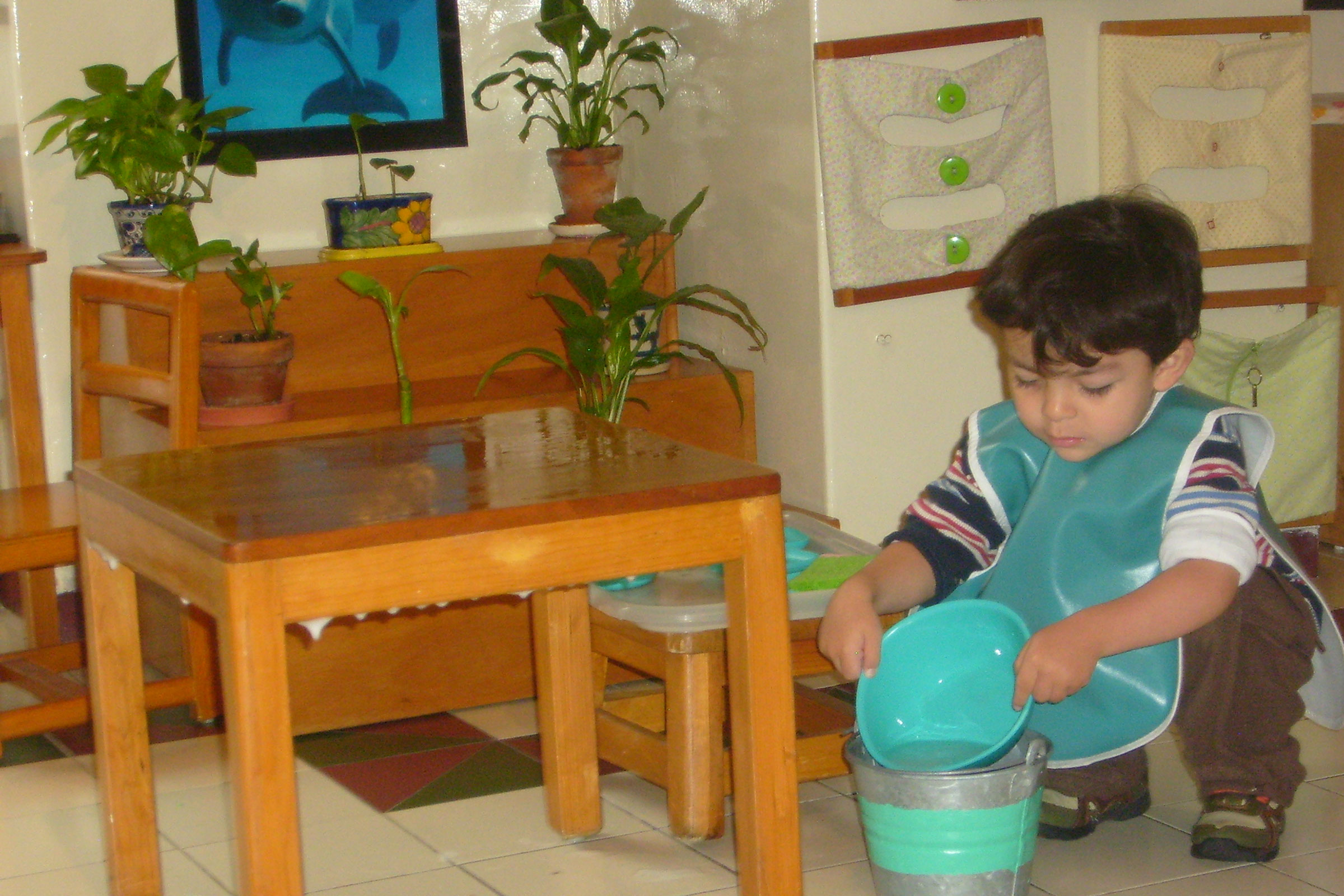
Working with the Practical Life material is essential for impulse control and the development of will, since children must constantly solve problems and make decisions. When they make mistakes or are not successful in the task it leads children to repeat the activities. In this path of trial and error they must control their impulses in order to obtain the results they expect and be successful.
For example, to wash a table they need to moisten, soap, wash and dry. For this they need different, very precise movements and also a logical sequence of steps or movements that lead to the table being clean. If, for example, they lather up before moistening, they won't see the foam on the table and won't be able to wash it. As the material gives them feedback about their work, they help strengthen their will, movement and inhibition.
Their search for results also evolves with age. At the beginning the inhibition and the will are not yet so strengthened, and they probably wash the table because of the internal satisfaction they receive, such as the touch of soap. As they grow up the will to find the final result appears more strongly: consciously they will seek to make their movements more and more precise and voluntarily and consciously they will seek to do only those that serve them to achieve their goal - that the table is really clean.
Beyond their own choice, there are also times when they have to decide what not to do or how to do things. For example, when they decide to walk instead of running so that they do not break some glass or have elements fall off a tray; or when they arrange materials so that another child can use them. All the time, they make small decisions that lead them to make voluntary movements, inhibiting others that are not necessary or inhibiting their own impulses. They also voluntarily decide how long to be with each job, or how many times to repeat the activity.
In the Montessori environment, children face small daily decisions that strengthen and develop their will and advance in the acquisition of the executive function of inhibition. This allows them to know themselves and be able to decide according to their abilities, tastes or desires; and in the future also for the benefit of others. Above all, freedom of action and choice in an environment suitable for their development allows each child to begin their work from their individuality, and to build themselves from action. All this fundamental work is the basis for later developing the other executive functions.
5. Interventions to Promote Development
The studies review scientific literature that reports several interventions that have been shown to be effective in the development of executive functions. These interventions include varied activities from non-computerized games, songs, to working memory training programs. Dr. Adele Diamond is one of the pioneers in this field and has documented how various activities such as yoga and mindfulness practice can improve executive functions in children.
In addition, the Montessori approach proposes a learning environment where freedom of choice with limits and movement are fundamental. Hands-on activities and work are key tools in this approach, allowing children to develop their will and inhibition skills effectively.
6. The Game of Silence and Its Meaning
One of the most emblematic Montessori activities is the "Game of Silence". This activity allows children to practice controlling their movement and developing their inhibition in a social setting. It can only be performed when children have reached a certain degree of development in their motor and social skills. During play, children must remain still and quiet, which requires a high level of self-control and attention.
Not only is this game a fun activity, but it also represents a milestone in the development of will and the executive function of inhibition. Children who successfully participate in this game demonstrate greater control over their movements and an improved ability to follow rules and work as a team.
7. Conclusions
In conclusion, the development of will and the executive function of inhibition in children aged 3 to 6 years is a complex process that requires attention and understanding from educators and parents. There are clear indicators of typical development, and it is essential to recognize the importance of autonomy and decision-making capacity in children taking into account the importance of cognitive development and the development of will with the development of executive functions.
The scientific literature supports the need to create environments that encourage freedom of action, choice, and movement, allowing children to develop their will in healthy ways. Through appropriate interventions and an educational approach that values initiative, we can help children reach their full potential in these areas critical to their holistic development.
Bibliography/References
- www.psiquiatria.com/glosario
- Montessori, M. (1936). The child. The Secret of Childhood (ed. 2015). Ed. Montessori-Pierson Publishing Company
- Klimkeit, E. I., Mattingley, J. B., Sheppard, D. M., Farrow, M., & Bradshaw, J. L. (2004). Examining the Development of Attention and Executive Functions in Children With a Novel Paradigm. Child Neuropsychology, 10 (3), 201–211.
- Lezak, M. D. (1982). The problem of assessing executive functions. International journal of Psychology, 17(1-4), 281-297.
- Klingberg T, Fernell E, Olesen PJ, Johnson M, Gustafsson P, Dahlström K, Gillberg CG, Forssberg H, Westerberg H.(2005) Computerized training of working memory in children with ADHD--a randomized, controlled trial. J Am Acad Child Adolesc Psychiatry. Feb; 44(2):177-86.
- Ardila, Alfredo & Ostrosky, Feggy. (2008). Historical Development of Executive Functions. Journal of Neuropsychology, Neuropsychiatry and Neurosciences.
- Holmes J, Gathercole SE, Dunning DL. (2009) Adaptive training leads to sustained enhancement of poor working memory in children.
- Diamond A, Lee K. (2011) Interventions shown to aid executive function development in children 4 to 12 years old. Science. Aug
- Diamond A. (2012) Executive functions. Annu Rev Psychol. 2013;64:135-68. doi: 10.1146/annurev-psych-113011-143750.. PMID: 23020641; PMCID: PMC4084861.
- James A. Griffin, PhD, MPH, and Peggy McCardle. (2016). Executive Function in Preschool-age Children: Integrating Measurement, Neurodevelopment, and Translational Research United States: American Psychological Association.
- Diamond A, Ling DS. Conclusions about interventions, programs, and approaches for improving executive functions that appear justified and those that, despite much hype, do not. Dev Cogn Neurosci. 2016 Apr;18:34-48.
- Touroutoglou A, Andreano JM, Adebayo M, Lyons S, Barrett LF. (2019) Motivation in the Service of Allostasis: The Role of anterior Mid Cingulate Cortex. Adv Motiv Sci.
- Souissi S, Chamari K, Bellaj T. (2022) Assessment of executive functions in school-aged children: A narrative review. Front Psychol
- Diamond A, Lee K. (2011) Interventions shown to aid executive function development in children 4 to 12 years old. Science.
- Geronimi EMC, Arellano B, Woodruff-Borden J. Relating (2020 ) Mindfulness and executive function in children. Clin Child Psychol Psychiatry. Apr; 25(2):435-445.
- Daniela W. Suárez (2021) "Play as a pedagogical strategy to strengthen Executive Functions in children"
- Souissi S, Chamari K, Bellaj T. (2022) Assessment of executive functions in school-aged children: A narrative review. Front Psychol
- Montessori Maria (ed. 2016) The Child,Society and the World
Maia Astoul Bonorino, AMI 3–6 Trainer