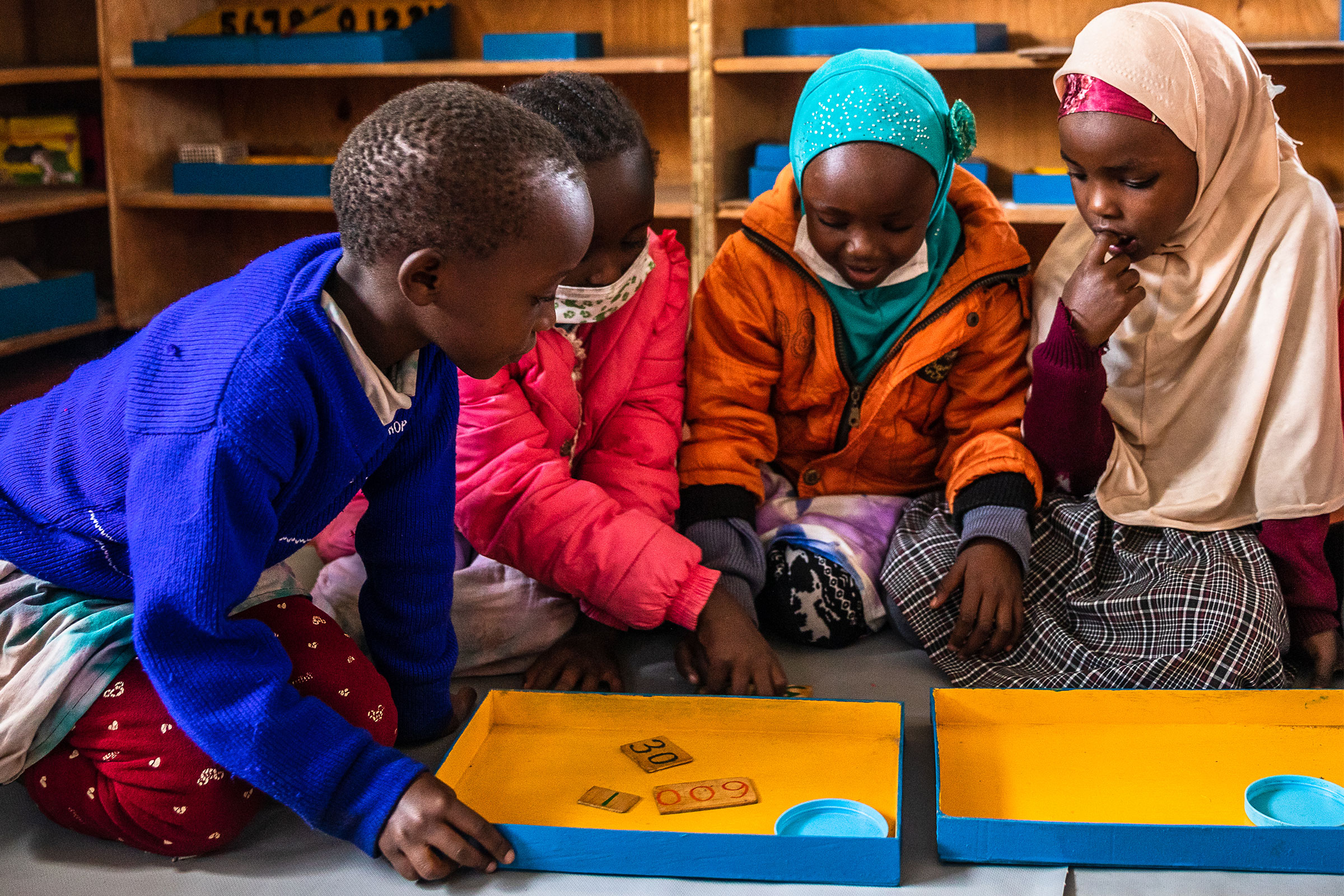
My education journey began in 2000 when I trained as a public school teacher in Ghana. However, shortly after this, I discovered the Montessori philosophy that would shape my professional life. With the support of the Protestant church in Metzingen-Neuhausen, Germany, and my parents, both dedicated nurses, we were granted land by my grandfather, who was the chief of my community, to build a school. Gumyoko Primary School is now the only public school in Ghana offering children Montessori education for free. The German sponsors of the school envisioned an education system based on Montessori principles, but at that time, there were no Montessori teacher training programmes available in Ghana.
Determined to realise this vision, I was sent to Germany in 2001 for Montessori training. Over the next three years, I immersed myself in the Montessori philosophy Deutsch, preparing for the task ahead, which was to implement Montessori in Gumyoko Primary School. Upon returning to Ghana in 2003, I started the first Montessori class with a total population of 60 students and a high school leaver as my assistant. As the school grew and the academic year passed, the impact of the Montessori approach became evident to parents and education authorities alike. The demand for Montessori education increased, but the challenge was the lack of Montessori-trained teachers. What began as a necessity soon became a calling for the training of more high school leavers to take up more classes. Witnessing the transformation of these young adults and their amazement at the effectiveness of Montessori materials fuelled my desire to formally train more teachers locally.
I started my AMI elementary training in Milwaukee from 2008 to 2010 and returned to Gumyoko with more Montessori knowledge in English. I continued to spread the Montessori philosophy in Gumyoko and other schools in Ghana. More teachers gained more training from me while I also taught a class. In a couple of years, I rose to the rank of head of school before leaving in 2018. For one year, I worked as Country Director for PAMBE Ghana, a non-profit education organisation with Montessori philosophy as its guiding principle.
Today, Association Montessori International has only six affiliated training centres in Africa, a continent with a population of 1.5 billion people. The need for Montessori teacher training centres cannot be overemphasised. This reality motivated me to begin my journey to become a Montessori teacher trainer. In 2013, I was given the opportunity to start and mentor teachers for the Corner of Hope in Nakuru, Kenya. This was a challenge I happily embraced since I was eager to contribute to the development of Montessori. This gave me more opportunities to mentor potential elementary teachers with the knowledge I had. Working with seasoned colleagues who joined me from 2015 to 2017 cemented my desire to become a trainer, which formally started in 2021 when I was accepted into the training of trainers programme.
Throughout my journey, I have faced numerous challenges. When I was interviewed to begin my training programme, my mentor advised me to cultivate a more robust reading and writing habit. This has led to purchasing more Montessori literature, travel for training, and other costs. Despite the support from agencies supporting this course, I've had to take on full teaching responsibilities to support my family while undergoing this training. Teaching full-time in a classroom and being in the training programme extends the duration of my training. This programme has since exposed me to a vast body of Montessori literature, deepening my knowledge of the philosophy and gaining practical skills from practicing trainers.
Despite these challenges, my determination remains unwavering. My ultimate goal is establishing an AMI-affiliated Montessori school and teacher training centre in Ghana. At the same time, I make myself available for training in the rest of Africa and the world at large.
Since AMI advocates the United Nations Convention on the Rights of the Child, increasing access to Montessori teaching and training in Africa will contribute immensely to realising this goal. Apart from increased access to AMI-affiliated training, the costs of training, which average fifteen thousand dollars ($15,000.00), are far beyond the reach of the average African. I, therefore, take this opportunity to call upon AMI, the global Montessori community and other educational agencies to support efforts to make Montessori training more affordable in Africa. Reducing the cost of Montessori education would make it more accessible and help achieve the SDG goals more efficiently.
In closing, I express my profound gratitude to all those working to advance Montessori education in Africa. Your dedication is making a difference in the lives of countless children and families. Let us continue to work together to ensure that every child on this continent has access to the transformative power of Montessori education, with all the supported agencies already partnering with us in diverse ways.
Eric Gumah, AMI 6–12 Trainer in Training