“What’s happening?” I asked my mother on the evening of July 7, 1998. I watched her closely. She was usually calm, but now I didn’t recognise her.
Only later did I understand. It was the legendary clash between Brazil and the Netherlands at the FIFA World Cup in France. We lost after penalties.
That moment sparked something in me. The next day, at the age of five, I received my first ball. The journey had begun.
By eight, I was invited to try out for a professional academy. It fuelled my fire but also made the disappointment sharper when I was told I wasn’t “coachable.” In truth, I simply didn’t understand the language. We were told to “pinch” without the ball apparently meaning to make the field smaller as a team.
But how do you make a field smaller?
You can imagine that my coaches were not Montessori-trained.
Still, my love for football continued. From the dressing rooms to the streets, I met children from diverse cultural backgrounds, learning about languages, rituals, and values far beyond my own world. Football became a mirror. It taught me resilience, teamwork, and that individuals thrive within a collective. It supported emotional regulation and deepened my awareness of physical and mental well-being.
At the same time, my love for the game was challenged by constant messages that I wasn’t good enough, and over time I stopped feeling seen as an individual and began to believe it.
Looking back, I realise: football shaped me, but not always in service of me as a child. The core issue is that sports are often designed for adults and imposed on children.
Luckily, in Montessori, we understand the importance of the prepared environment. Through training, we can prepare sports environments that respond to the child’s needs, interests, characteristics, and skill level. Adults are called to transform themselves and do the inner work necessary to truly be in service to the child enabling them to develop their potential.
And yet, if we are honest, sports and physical education have often held an uneasy place within Montessori environments. It remains an area that deserves more conscious attention.
Part of this tension is historical. When Maria Montessori developed her work over a century ago, the modern sports industry did not yet exist. Today, sports has become a billion-dollar entertainment industry - primarily for adults - often framed in ways that resemble conflict: teams competing for victory in the arena.
Not long ago, we had gladiators: I live when you die.
Today, the language is softer, but the essence often remains: I win when you lose.
At times, sport also becomes entangled with politics, including the 2026 World Cup. This can create distance for those who feel no connection to it.
But it doesn’t have to be this way. It begins with us and the lens through which we choose to observe. Because if we truly follow the child, many will lead us here: to play, to games, to football.
This is why the 2026 FIFA World Cup matters, not just as a spectacle, but as a moment that will shape how millions of children experience football. This World Cup will be the largest and most far-reaching in history. For the first time, 48 countries will compete across 104 matches, hosted jointly by the United States, Mexico, and Canada spanning an entire continent. With over 5 million fans expected in stadiums and more than 6 billion people engaging worldwide through broadcast and digital platforms, its global influence is unprecedented. Beyond sports, it represents a powerful cultural moment, shaping how children and adults alike experience football, identity, and connection.
Football can also carry profound human stories. Take Didier Drogba and the Côte d’Ivoire national team. After qualifying for the 2006 World Cup, Drogba and his teammates knelt on live television to plead for an end to their country’s civil war. Later, by playing a match in a rebel-held stronghold, they helped bring opposing sides together in one stadium. In that moment, football did what politics could not by creating space for unity and peace.
Additionally, this 2026 World Cup also emphasises long-term impact through youth initiatives. Investments in local competitions, community pitches, materials, and coaching aim to ensure the game continues to grow well beyond the tournament. In this context, it is meaningful that Montessori Sports, together with AMI/USA, has submitted an application to the FIFA Education Fund to support access to quality education and sports for children in underserved communities.
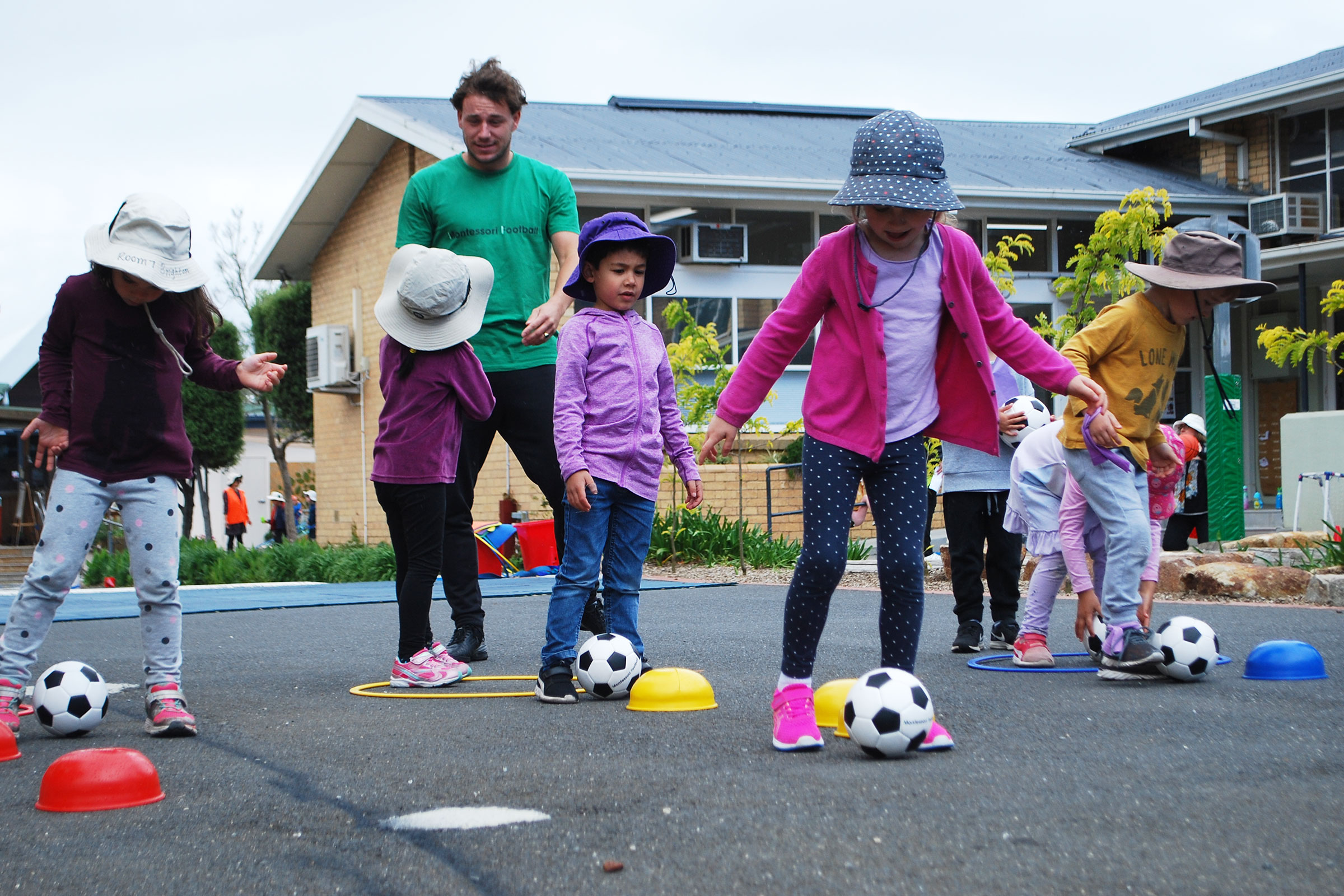
With the world watching, this momentum offers a unique opportunity: to demonstrate how football can serve the child through prepared environments, child-sized materials, and guidance that meets each child’s developmental needs.
To conclude, our choices will determine whether this World Cup ignites a spark in children and whether that flame is nurtured or fades. If we want to place football in service of the child, it starts with small, intentional choices. You can consider doing the following:
- Prepare your own World Cup corner with materials and activities relevant to the children.
- Connect to Cosmic Education through stories like The Story of the Ball, linking football to the human body, nutrition, health, history, and culture.
- Explore world maps, flags, and countries of participating teams to deepen global awareness.
- Identify the many roles and jobs on and off the field together with the children.
- Observe and break down the fundamental movement abilities needed to enjoy the game.
Jip Bartels, AMI Montessori Sports Trainer