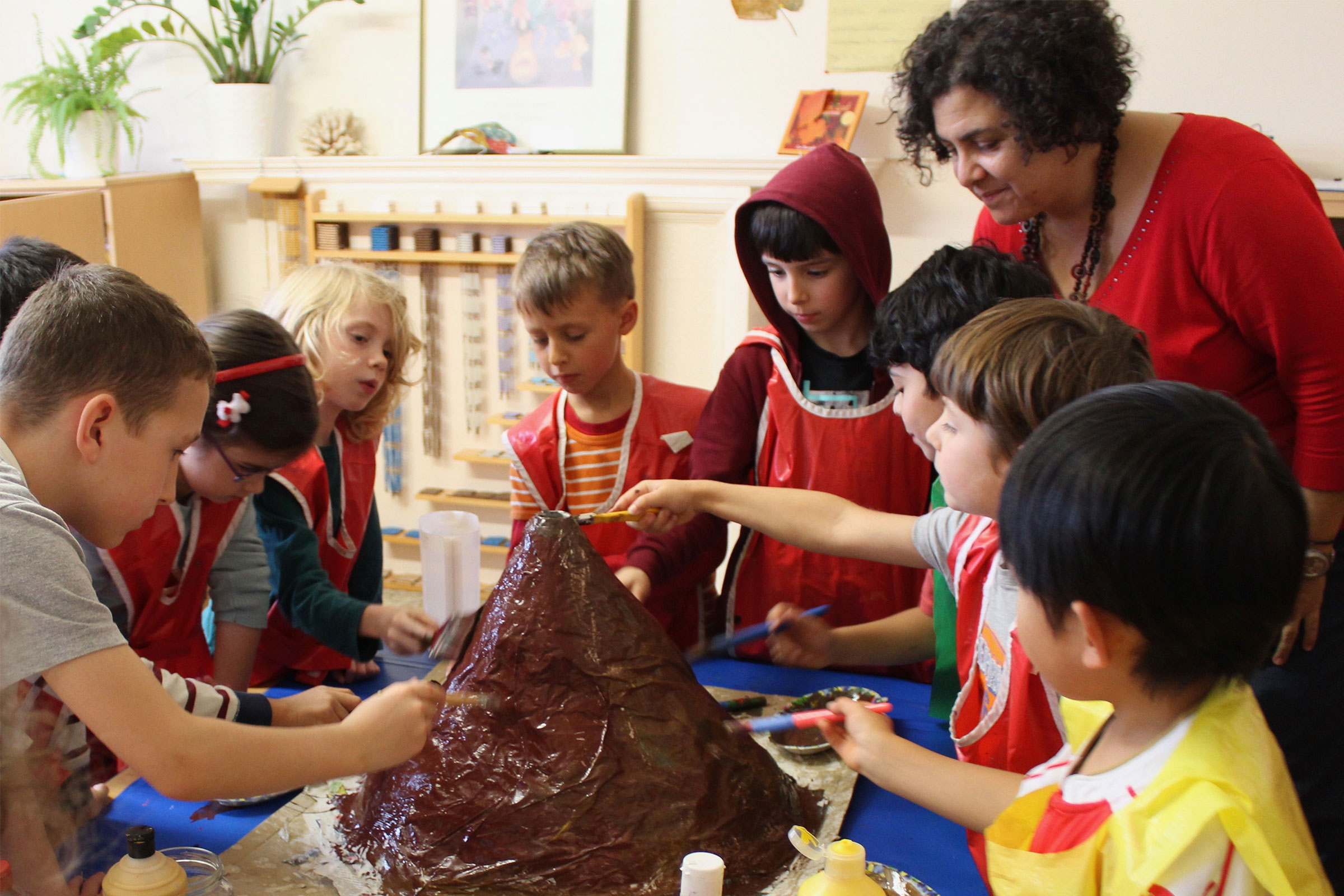
Human Tendencies are a recurring theme in the writings of Maria and Mario Montessori when discussing the prepared environment, as they are considered tools that drive human beings to develop and adapt to the environment in which they live from the moment of birth.
In the book, "Citizen of the World," Dr. Montessori mentions that "Adaptation is the starting point; it is the foundation of development. Since one of the child's tasks is to construct himself, it is necessary for him to first adapt to the environment in which he develops, and tendencies are the tools that will promote this adaptation."
If we start from this idea, it is necessary to understand that our role as adults is to promote children's adaptation to their environment. It is important to recognise that human tendencies, while the same from birth, are expressed differently according to the characteristics and needs of each level of development.
In the first stage of development, the child is a sensory explorer, and tendencies operate sensorially. With the help of the absorbent mind and sensitive periods, the child acquires the characteristics of the human group in which they were born and at the same time adapts by making them their own.
In the second stage of development, tendencies operate differently, as the absorbent mind now transforms into a reasoning mind that can classify experiences, make decisions, and draw judgments and conclusions. At this stage, tendencies, along with imagination, will be the tools that help children find answers to the endless questions they ask themselves. They are no longer content with knowing the facts; they now want to know the how, when, why, and what for of the environment in which they live, in order to understand how it works and thus be able to adapt to it.
Our responsibility as Montessori educators is to ask ourselves if we truly take children's tendencies into account when preparing the environment. How aware are we that, through our daily work in giving presentations, that we are fostering the use of tendencies in the child's self-construction? How do we help develop tendencies in the elementary classroom?
Dr. Montessori's pedagogical approach was based on observing children's characteristics and needs, thus supporting the manifestations of human tendencies within the environment prepared in the children's daily work.
Exploration: Within the environment are developmental materials such as impressionist posters, experiments, exercises, and activities such as dissection, microscope use, and research. In the external environment, there is contact with nature, and contact with society occurs through "Going Out." In other words, exploration is the tendency that helps us know and understand the world and answer all its questions.
Orientation: Physically, this allows for location in time and space both inside and outside the environment. On a psychological and emotional level, orientation is based on boundaries, which are the rules of behaviour for healthy coexistence based on respect, responsibility, and the achievement of freedom and independence.
But it is also found in the order and sequence of materials on the shelves. It is clear that when giving a presentation, this tendency is being used along with observation so that the child can see how to work with the material and, through repetition, achieve learning.
Order: This tendency is what will give the child the internal structure necessary to function adequately in any life situation. It is the foundation that will allow them to classify the experiences they have inside and outside the environment. Therefore, it is necessary to maintain order in the environment, establish routines, and take responsibility for the care of the environment, including their belongings.
Communication: This tendency provides the opportunity to build a bond with people, in addition to fostering the sharing of ideas, feelings, and opinions, and, above all, understanding that it is the basis of socialisation, which is one of the characteristics of children between 6 and 12 years old.
Work: This is the opportunity to develop skills to be productive and to achieve independence and freedom. It is through the manipulation of materials that children will achieve learning through their own efforts, doing things for themselves while following their internal guidance. Work should arise from the child's interest and never to meet public education requirements, which are merely a complement to the adaptation process.
Repetition, accuracy, and refinement: These support the development of the mathematical mind, which is the logical and analytical part of the mind, which follows a process of starting from the concrete to achieve abstraction. It is also understood that through the use of developmental materials, learning is a personal achievement that fosters intellectual development.
Spirituality: Spirituality is the essence of being human, so we need to understand that spiritual development is a process of searching, self-knowledge, connectivity, and maturation, which fosters personal growth and the development of one's life purpose.
Belonging: This is the achieving of adaptation and integration of individuality into the community in which one lives, based on respect and acceptance.
We can conclude that meeting the needs of children aged 6 to 12, utilising their human characteristics and tendencies, is contained in what Maria and Mario Montessori called Cosmic Education, whose purpose goes beyond the connectivity of all that exists. The deeper purpose is to strengthen the essence of the child, making them aware that everything in nature has a purpose for existing, including them.
Carmela Fierro, AMI 6–12 Trainer