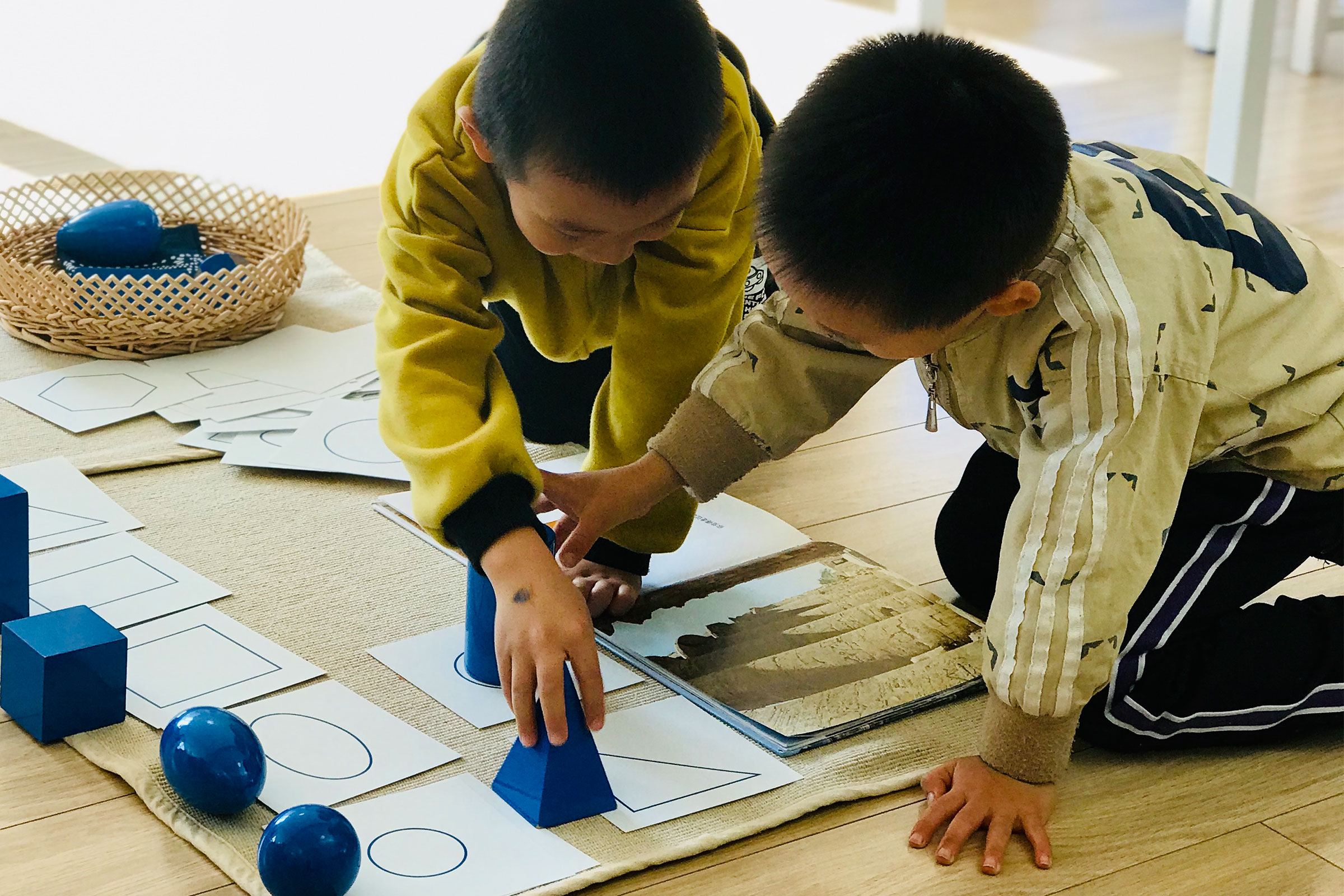
Hello, I’m Esther, an AMI 3–6 trainer. I have been working in Montessori education for many years and currently focus on teacher training. Over the years, through both classroom practice and training, I have been reflecting on one question: in a rapidly changing world, what are the abilities children truly need to develop? This article is a reflection based on these observations and ongoing thinking.
In the era of rapid development of artificial intelligence, access to knowledge has become easier than ever before. Within seconds, we can obtain answers, generate texts, and complete tasks that once required extended thinking. Yet a critical question emerges: when answers are readily available, are we still truly thinking?
A study from MIT Media Lab offers a warning. Participants using large language models (LLMs) in writing tasks showed reduced brain engagement, along with weaker memory and recall (Kosmyna et al., 2024). This phenomenon, known as “cognitive offloading,” reflects a shift in which learners transfer cognitive processes to external tools. As technology begins to think for us, our own engagement in learning diminishes.
The issue, therefore, is not whether or not we use AI, but how we use it. When used critically, AI can support understanding and thinking; when used to generate information that is copied and pasted, without review, it may interrupt the learning process. In an age where information is highly accessible, what matters is not the acquisition of answers, but the ability to understand, evaluate, and regulate information.
However, traditional education often emphasizes instruction, memorization, and external evaluation, yet these approaches do not necessarily develop the learner’s ability to regulate their own learning process (Lillard, 2017).
In this context, self-regulated (SRL) learning provides an important framework for understanding the learning process. According to Barry Zimmerman (2002), self-regulated learning refers to the process in which learners set goals and monitor and regulate their cognition, motivation, and behaviour. This aligns with the perspective of Stanislas Dehaene, who identifies active engagement as a fundamental condition for learning (see AMI Training Voices: Neuroscience of Learning). Learning is not the acquisition of answers, but a process of active participation, processing, and construction. What matters, therefore, is not simply what is learned, but whether one has learned how to learn.
At a deeper level, self-regulated learning is not only reflected in behavioural regulation, but also involves metacognition—the awareness and understanding of one’s own learning process. In Montessori environments, children engage in activities that provide feedback, apply prior knowledge in new contexts, and consolidate their understanding by helping others. In mixed-age settings, these opportunities are particularly significant, as explaining and demonstrating to others deepens children’s awareness of their own understanding.
This process also relies on executive function (EF), including inhibition, working memory, and cognitive flexibility, which enable learners to continuously adjust their behaviour. Self-regulated learning is therefore not a single ability, but a dynamic process emerging from the interaction between metacognition and executive function.
Maria Montessori observed that children aged 0–6 experience a series of sensitive periods, during which they are drawn to specific elements in their environment. She also described human tendencies—such as exploration, order, and repetition—as the underlying forces that drive development.
Sensitive periods make children particularly responsive to certain elements in the environment, enabling human tendencies to be expressed through interaction. Through sustained activity, this process supports absorption and contributes to the formation of neural networks, which in turn support the development of language, coordination, and other abilities. Thus, Montessori environments are not organized around academic content, but around developmental needs, allowing children to construct abilities through interaction with their environment.
Within this framework, the Montessori practical life activities provide children with their earliest essential experiences. These activities are defined by clear, real-life goals. For example, when a child attempts to button clothing, the outcome is directly observable. This clarity enables children to act toward a result and to adjust when it is not achieved.
Rather than relying on adult evaluation, children develop independent judgment through repeated cycles of attempt and feedback in activities such as self-care and care of the environment. This cycle forms the structural foundation of self-regulated learning, shifting learning from external correction to self-regulation. In contrast, in open-ended activities without clear goals, children are less able to evaluate their actions and therefore less likely to develop sustained monitoring and adjustment.
In Montessori environments, this process typically begins with a precise presentation by the teacher, providing the child with a clear model of action. The child then engages in independent repetition, continuously adjusting and refining actions based on results, gradually refining both movement and understanding. In this process, the child’s concentration does not arise from external demands, but from internal drives and the engagement evoked by the teacher’s presentation. Through repeated action and feedback, behaviour becomes increasingly stable and refined.
This process reflects the four pillars of learning identified by Stanislas Dehaene: attention, active engagement, error feedback, and consolidation.
This development extends beyond practical life. In Montessori environments, sensorial, language, and mathematics materials similarly support the development of learning capacity. For example, in sensorial activities, children develop abilities of comparison, judgment, and classification through pairing, grading, and sorting (such as arranging objects by size or matching colours). In mathematics activities, children gradually construct an understanding of quantity and mathematical concepts through concrete materials and sequential operations (such as counting or combining using bead chains).
In this process, children are not only acting, but continuously evaluating whether the outcome matches the goal and adjusting their behaviour accordingly. This reflects the development of critical thinking, and this ongoing evaluation and adjustment is a key expression of monitoring and regulation within self-regulated learning.
These materials also incorporate clear goals and built-in control of error, enabling children to evaluate outcomes independently and adjust their actions. Thus, the materials not only support the acquisition of content, but also provide the conditions for the development of self-regulated learning.
In The Creative Development of the Child, Montessori indicates that language and mathematics both serve as means to organize the mind. Therefore, Montessori materials are not merely carriers of knowledge. Reading and mathematical abilities are not the final goals; rather, the core function of these materials is to support the development of learning itself. Through interaction with materials, children are not only learning content, but learning how to set goals, act, evaluate, and adjust their own learning process. This reflects Montessori’s concept of psychopedagogy, in which structured materials support the development of thinking. In such an environment, learning is no longer the accumulation of knowledge, but the construction of capability.
“In our schools we consider language and mathematics as a series of mental exercises which develop the personality… Instead of treating them as two separate subjects, we tackle them in such a fashion that they are continuously penetrating into the mind, and growing with the personality.” (Montessori, The Creative Development of the Child).
Freedom of choice and guided demonstration support the transition from external instruction to internal construction. At the same time, the progression from simple to complex activities allows children to gain success within appropriate levels of challenge. Appropriate challenge is essential for sustaining attention and active engagement. When the level of challenge matches the child’s ability, the child is more likely to remain focused and persist in activity, thereby building confidence and gradually developing the ability to independently choose, begin, and sustain new tasks. This experience of adjusting within achievable yet challenging conditions is essential for the development of self-regulated learning.
Therefore, self-regulated learning is not only a key concept in contemporary educational research, but also provides an important framework for understanding the nature of learning. More importantly, Montessori education does not merely offer a perspective on learning, but continuously supports the development of self-regulated learning through its environment and practices, allowing it to become a way of learning. In contrast, mainstream educational models often centre on instruction, scaffolding, and correction, with fewer opportunities for children to act at their own pace and adjust independently. In such environments, learning is more likely to be understood as listening and memorizing, following a pattern of “teaching and testing,” rather than a process of active participation and regulation by the learner.
What children develop in such an environment is not only knowledge and skills, but the capacity for continuous learning and self-adjustment. As Angeline Lillard (2017) suggests in her discussion of a paradigm shift in education, the key to rethinking education lies in understanding how children learn, rather than what they learn.
In the age of artificial intelligence, as answers become increasingly accessible, this capacity to “learn how to learn” becomes essential. It enables learners not only to use tools, but to maintain thinking while using them, and ultimately to become individuals who continue to be excited about learning, rather than merely seeking the answer.
Esther Ho, AMI 3–6 Trainer