Le Diagon, S., Van der Henst, J.-B., & Prado, J. (2025). Early Montessori education shows delayed benefits for mathematical problem-solving in a 5-year longitudinal randomized controlled trial. Scientific Reports, 15(1), 43961. https://www.nature.com/articles/s41598-025-27687-2.pdf
In 2021 an article published in the prestigious journal Child Development (Courtier et al., 20201) used the most rigorous lottery design to examine Montessori preschool outcomes: All the 3-year-olds entering a public school in a low-income area of Lyons, France were randomly assigned to either Montessori or regular classrooms. Although this study was very strong in many ways--pre-registered and very rigorous--it had a major drawback: two Montessori classroom teachers were "self-trained" and the third was in training when the study began, among other compromises like short work periods and lacking full sets of materials. That said, the teachers were surely studying as best they could. Although on most measures, control children getting the French national public preschool curriculum (almost all countries have a national curriculum--unlike the US and Canada) did as well, the adapted Montessori approach clearly led to better reading by the end of the kindergarten year.
Le Diagon et al. followed up on this sample five years later, when the participants were in 5th grade. This is key in the context of early childhood interventions. While the Perry Preschool Project and the Abecedarian Project in the 1970s both found better long-term outcomes for children randomized to early interventions (Baulos et al., 2024; Campbell et al., 2014), recent studies frequently found no effects (Burchinal et al., 2024; Schneider et al., 2024) or, even worse effects in 3rd and 6th grade (Durkin et al., 2022). A pattern of early benefits followed by "convergence", where the control group catches up to the intervention group, is most common.
In 5th grade, the researchers expected everything would be the same except for reading, at which they expected those who had attended Montessori preschool would still excel. This is not what they found. Instead, the Montessori group had converged in reading--their scores were no different. On the other hand, one new difference had robustly emerged: math. And a test of emotion understanding--namely being able to read emotion from the eyes alone--was also stronger in those who had had Montessori preschool. All the participants had been in the same conventional French system since 1st grade, hence for 5 years.
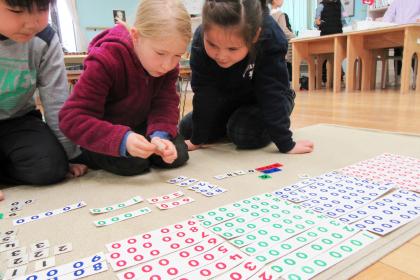
What are we to make of this? I recently reviewed all Montessori studies and saw this same pattern, discussed in the forthcoming The Montessori Difference: Considering the Evidence (Oxford University Press). Montessori students very often do better than comparison students in reading while they are in Montessori, but in studies examining former Montessori students who no longer attend Montessori, that advantage is rarely observed. Contrast, for example, Denervaud et al. (2019) with Dohrmann et al. (2007). The former found clear reading advantages for children in Montessori both at ages 5 and 12, whereas Dohrman saw no high school (ages 15-18) reading advantages for students who had been in Montessori schools through 5th grade (age 11). In math, however, a different pattern emerged. Although that same Denervaud study saw a math advantage at both ages, many others see no advantage on standardized math tests before 4th grade (e.g., Mallett & Schroeder, 2015); disadvantage in the middle of elementary school has even been observed (Lopata et al., 2005; Snyder et al., 2022). While the reasons for this may vary, and include the fidelity of the programs, the strength of the counterfactual, and the specific assessment (i.e., how deeply did it probe understanding, versus simply identifying a memorized procedure), it seems that math advantages in Montessori are inconsistently observed prior to about age 10. After that, however, they are often observed, and (unlike for reading) even when children are no longer attending Montessori schools! Dohrmann saw this, and so did the present study. The authors suggest, and I concur, that Base-10 understanding could be at root for the math advantage, because the rest of mathematics builds on basic understandings, and math tests reflect this. Younger Montessori students do very advanced math with materials that embody why math works; the knowledge becomes abstract around age 10, and from there on the students can excel at standardized tests, which by their very nature are abstract, but benefit from deep understanding (rather than merely memorizing formulae). By contrast, having learned to read earlier may not translate to doing better years later on a reading comprehension task on a standardized test.
A last short call-out to the emotion recognition finding, which the authors interpret cautiously. A later Denervaud et al. study (2020) also showed that Montessori students are more sensitive to facial expression. Research on this is quite slim, but the fact that both studies showed it suggest it's an interesting issue to explore.
Angeline S. Lillard
University of Virginia
References
Baulos, A. W., García, J. L., & Heckman, J. J. (2024). Perry Preschool at 50: What Lessons Should Be Drawn and Which Criticisms Ignored?
Burchinal, M., Whitaker, A., Jenkins, J., Bailey, D., Watts, T., Duncan, G., & Hart, E. (2024). Unsettled science on longer-run effects of early education. Science, 384(6695), 506-508.
Campbell, F. A., Conti, G., Heckman, J. J., Moon, S. H., Pinto, R., Pungello, E., & Pan, Y. (2014). Early childhood investments substantially boost adult health. Science (New York, N.Y.), 343(6178), 1478-1485. https://doi.org/10.1126/science.1248429
Denervaud, S., Knebel, J.-F., Hagmann, P., & Gentaz, E. (2019). Beyond executive functions, creativity skills benefit academic outcomes: Insights from Montessori education. PLoS ONE, 14(11), e0225319. https://doi.org/10.1371/journal.pone.0225319
Denervaud, S., Mumenthaler, C., Gentaz, E., & Sander, D. (2020). Emotion recognition development: Preliminary evidence for an effect of school pedagogical practices. Learning and Instruction, 69, 101353.
Dohrmann, K. R., Nishida, T. K., Gartner, A., Lipsky, D. K., & Grimm, K. J. (2007). High school outcomes for students in a public Montessori program. Journal of Research in Childhood Education, 22(2), 205-217.
Durkin, K., Lipsey, M. W., Farran, D. C., & Wiesen, S. E. (2022). Effects of a statewide pre-kindergarten program on children’s achievement and behavior through sixth grade. Developmental psychology.
Lopata, C., Wallace, N. V., & Finn, K. V. (2005). Comparison of academic achievement between Montessori and traditional education programs. Journal of Research in Childhood Education, 20(1), 5-13. https://doi.org/https//doi.org/10.1080/02568540509594546
Mallett, J. D., & Schroeder, J. L. (2015). Academic achievement outcomes: A comparison of Montessori and non-Montessori public elementary school students. Journal of Elementary Education, 25(1), 39-53.
Schneider, B. H., Manetti, M., Rania, N., Tomas, J. M., Oliver, A., Coplan, R. J., & Taylor, Q. (2024). A longitudinal study of school adjustment among children attending Reggio-inspired preschools. International Journal of Behavioral Development, 48(1), 1-11.
Snyder, A., Tong, X., & Lillard, A. S. (2022). Standardized test performance in public Montessori schools. Journal of School Choice, 16(1), 105-135. https://doi.org/10.1080/15582159.2021.1958058

Other Articles
We welcome the active participation of the global Montessori community in recommending research for inclusion on these pages. Please reach out to the Global Research Group at [email protected] with any suggestions as well as comments on how this resource can be further expanded or improved.