Sierksma J., Brummelman E., “Here, Let Me Do It for You”: Psychological Consequences of Receiving Direct and Indirect Help in Childhood, Child Development, Volume 96, Issue 5, September/October 2025, Pages 1660–1674, https://doi.org/10.1111/cdev.14259.
“Here, Let Me Do It for You”: Psychological Consequences of Receiving Direct and Indirect Help in Childhood
This study by Sierksma & Brummelman (2025) looks at a very common moment in childhood: a child is working on a task, struggles, and an adult steps in to help — sometimes by giving the answer, sometimes by offering a hint. The researchers asked a simple but important question: How does receiving help actually make children feel, think, and behave?
Across three carefully designed experiments with over 600 children aged 7–9, the authors found something surprising and uncomfortable: unsolicited help often backfires.
When children were given help they hadn’t asked for, they tended to feel less competent, enjoyed the task less, felt more dependent on help and sought fewer challenges afterwards. This happened whether the help was direct help (i.e., here’s the answer) or indirect help (i.e., here’s a hint). In other words, even well-intentioned help sometimes sends an unintended message that you can’t do this on your own.
Importantly, the negative effects were not large, but they were consistent, appearing across different tasks, settings, and studies. That matters, because these small effects can accumulate over time and especially in classrooms or homes where adults frequently step in.
In understanding why this help has this effect the authors draw on two major psychological theories. First, self-determination theory suggests that children are most motivated when three basic needs are supported: Competence (“I can do this”), Autonomy (“I’m in control”) and Relatedness (“I’m supported, not judged”). When help is unsolicited, even gentle hints can undermine competence and autonomy at the same time.
Second, attribution theory explains that children naturally ask themselves why someone helped them. If help arrives without being requested, children may infer that they were helped because they were not good at this. Over time, this can shape how children see their own abilities.
What about hints versus answers? Many parents and teachers assume that giving hints is always better than giving answers. This study challenges that assumption. While children disliked direct help more and were more likely to deny they had received it, both types of help had very similar effects on confidence and motivation. Simply receiving help when it wasn’t asked for, seemed to matter more than the form of help.
The findings do not mean adults should never help children. Help is clearly beneficial when children ask for it, adults scaffold just enough to keep effort alive and help supports thinking rather than replacing it. But the study does suggest we should be cautious about stepping in too quickly. Children learn not only from success, but from struggle, effort, and working things out for themselves.
This research supports educational approaches that value:
- Allowing time for independent problem-solving
- Respecting children’s autonomy
- Offering help as an invitation, not an interruption
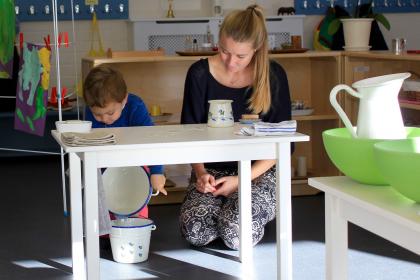
This is where Montessori education feels strikingly familiar. Maria Montessori built her educational approach around the idea that children develop best when they are allowed to act independently within a carefully prepared environment. Materials are designed to be self-correcting. Tasks are broken into manageable steps. Children are encouraged to repeat activities until mastery emerges naturally. The adult’s role is not to constantly intervene, but to observe, prepare, and support carefully when necessary. In Montessori classrooms help is delayed until the child truly needs it and errors are opportunities for learning, not immediate correction. Confidence grows through repeated self-directed success.
At a time when education often feels rushed, outcome-driven, and adult-directed, this research is a reminder that learning is a developmental process, not a performance. Sometimes, the most powerful thing an adult can do is pause and let the child try.
Louise Livingston, AMI Global Research Committee

Other Articles
We welcome the active participation of the global Montessori community in recommending research for inclusion on these pages. Please reach out to the Global Research Group at [email protected] with any suggestions as well as comments on how this resource can be further expanded or improved.